
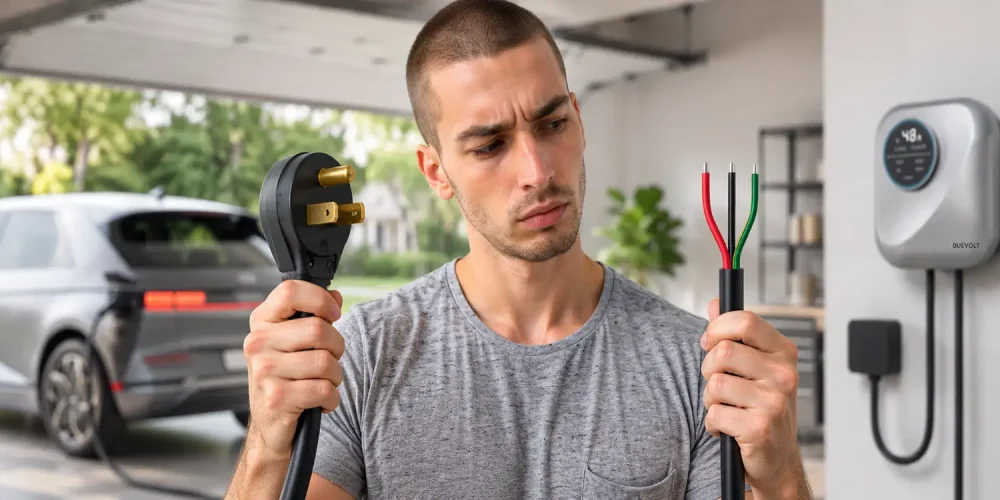
From charging speed and installation costs to everyday driving habits, here’s what you need to know before choosing your next home EV charger.
More Power or Better Value? Comparing Charging Speeds, Installation Costs, and Everyday Charging Needs to Find the Right Home EV Charger.
Choosing a home EV charger might seem straightforward until you start comparing charging power, electrical requirements, and installation costs. A 40A EV charger and a 48A EV charger are two popular Level 2 charging options in the United States. Both can deliver enough power to recharge most electric vehicles overnight, but their differences become more apparent when you consider your daily mileage and home electrical setup.
A 48-amp charger offers more power, but does that necessarily make it a better investment? And is the additional charging speed worth the potential installation expense? Let’s take a closer look.
40 Amp vs 48 Amp EV Charger: Key Differences at a Glance
Both chargers operate on a 240V power supply, but the difference in amperage determines how much power they can deliver to your vehicle.
| Specifications | 40A EV Charger | 48A EV Charger |
|---|---|---|
| Charging Level | Level 2 | Level 2 |
| Input Voltage | 240V | 240V |
| Maximum Current | 40A | 48A |
| Maximum Charging Power | 9.6 kW | 11.52 kW |
| Required Dedicated Circuit | 50A | Typically 60A |
| Installation Type | Plug-in or hardwired | Hardwired at 48A |
| NEMA 14-50 Compatibility | Yes, on a suitable circuit | Not at 48A |
| Portability | Available | Generally not portable |
The most obvious difference is charging power. A 48A EV charger delivers up to 20% more power than a 40A unit. However, charging speed is only part of the equation. Your vehicle’s onboard charger, available electrical capacity, and charging habits are equally important.
How Much Faster Is a 48A EV Charger Than a 40A EV Charger?
Charging Power: 9.6 kW vs 11.5 kW
Assuming an electric vehicle requires 35 kWh of energy to travel 100 miles, the theoretical charging times are as follows:
| Range Added | Energy Required | 40A Charger (9.6 kW) | 48A Charger (11.52 kW) |
|---|---|---|---|
| 30 miles | 10.5 kWh | 1.1 hours | 0.9 hours |
| 50 miles | 17.5 kWh | 1.8 hours | 1.5 hours |
| 100 miles | 35 kWh | 3.6 hours | 3.0 hours |
| 200 miles | 70 kWh | 7.3 hours | 6.1 hours |
These calculations assume a constant charging rate and exclude additional charging losses. Actual charging times may be longer depending on the vehicle, battery temperature, charging efficiency, and state of charge.
Unlike DC fast charging, Level 2 AC charging does not necessarily slow down significantly once the battery reaches 80%. However, some vehicles may reduce charging power as the battery approaches full capacity or when battery conditions require it.
While a few minutes may not matter when replenishing a short daily commute, the difference becomes more noticeable when charging a nearly depleted battery.
Real-World Charging Comparison: Ford Mustang Mach-E
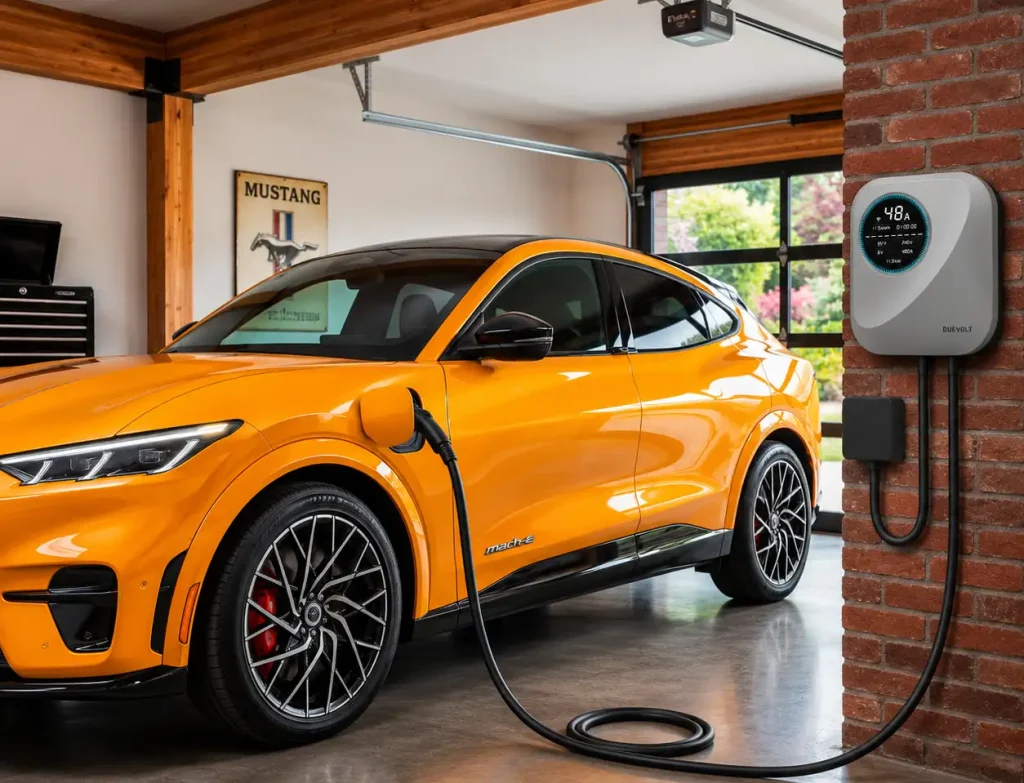
Let’s use the Ford Mustang Mach-E Select RWD as an example to illustrate how the two charging options compare.

Based on our illustrative charging calculations, a 40A EV charger takes approximately 5.5 hours to recharge the battery from 10% to 80%, while a 48A EV charger can complete the same task in approximately 4.6 hours.
That’s nearly an hour of charging time saved in a single session.
These figures are estimates for the selected vehicle configuration rather than manufacturer-certified charging times. Battery capacities and AC charging capabilities vary by model year, as shown in the official Ford Mustang Mach-E specifications.
Of course, most EV owners rarely arrive home with just 10% battery remaining. If your daily commute is around 30 miles, both chargers can replenish that energy in roughly an hour. The advantage of a 48-amp charger becomes much more meaningful for drivers who regularly need to recover a substantial amount of driving range.
Installation Differences: NEMA 14-50 vs Hardwired EV Chargers
Installing a 40A EV Charger
One of the biggest advantages of a 40A EV charger is its installation flexibility. Many models come equipped with a NEMA 14-50 plug, allowing them to connect to a properly installed 240V outlet on a dedicated 50-amp circuit.
If your garage already has a suitable outlet, you may be able to avoid the expense of installing an entirely new charging circuit. An electrician should verify that the receptacle, wiring, breaker, and available electrical capacity are appropriate for sustained EV charging.
A plug-in charger also offers the convenience of being relatively easy to replace or relocate.
Installing a 48A EV Charger
A 48A EV charger typically requires a dedicated 60-amp circuit and a hardwired connection. Since EV charging is considered a continuous electrical load, the circuit must be sized accordingly.
According to the U.S. EPA’s home EV charging installation guidance, the circuit breaker should be rated for at least 125% of the charger’s operating current.
This means:
- A 40A EV charger requires a 50A circuit to operate at full output.
- A 48A EV charger typically requires a 60A circuit to operate at full output.
A standard NEMA 14-50 outlet is not suitable for continuous 48-amp charging.
If your home already has adequate electrical capacity for a dedicated 60-amp circuit and the wiring route between your electrical panel and parking space is straightforward, installing a 48-amp charger may be a particularly attractive option.
Plug-In vs Hardwired: Which Is Safer?
A properly installed hardwired EV charger eliminates the plug-and-receptacle connection, reducing potential points of overheating, loose electrical contact, and wear caused by repeated plugging and unplugging.
This makes hardwiring an appealing choice for a permanent, high-power home charging installation. Nevertheless, a properly installed plug-in charger with a suitable receptacle can also provide safe and reliable charging.
Electrical licensing, permitting, and inspection requirements vary across U.S. states and local jurisdictions. Many locations require installation by a licensed electrician. Even where homeowner installation is legally permitted, consulting a qualified electrical professional is strongly recommended, along with following local electrical codes and the manufacturer’s installation instructions.
40 Amp vs 48 Amp EV Charger: Installation and Ownership Costs
Charging performance is important, but the total cost of setting up a home charging station often determines which option makes the most financial sense.
Charger Purchase Price
A portable 40A EV charger is generally less expensive than a dedicated wall-mounted charging station. Fixed home chargers may offer additional features, such as Wi-Fi connectivity, app-based scheduling, longer cables, more substantial enclosures, and permanent cable management.
Meanwhile, the purchase price difference between comparable 40A and 48A wall-mounted chargers may be relatively small. The bigger question is whether your home can accommodate the higher electrical load without expensive upgrades.
Electrical Installation Costs
The following example illustrates how equipment and installation expenses might compare for three different home charging setups.
| Cost Item | 40A Portable Charger | 40A Wall-Mounted Charger | 48A Hardwired Charger |
|---|---|---|---|
| Charger Purchase | $220 | $390 | $450 |
| Electrical Labor | $450 | $450 | $500 |
| Wiring and Conduit | $200 | $200 | $250 |
| Breaker and Outlet or Connection Materials | $150 | $150 | $100 |
| Permits and Inspection | $100 | $100 | $100 |
| Estimated Installation Cost | $900 | $900 | $950 |
| Estimated Total Cost | $1,120 | $1,290 | $1,400 |
These figures represent illustrative budgets for a new circuit installation, not guaranteed market prices or contractor quotations. Existing electrical infrastructure, regional labor rates, and installation complexity can significantly change the final cost. Major panel and electrical service upgrades are excluded.
If you already have a suitable NEMA 14-50 outlet, the installation expense for a plug-in charger could be substantially lower. Conversely, installing a 48A EV charger may not cost much more than installing a new 50-amp outlet if sufficient electrical capacity is already available.
For a more detailed breakdown of equipment, labor, and electrical upgrade expenses, see our guide to Level 2 EV charger installation costs.
Does a 48A EV Charger Increase Your Electricity Bill?
Not necessarily. Electricity consumption is measured in kilowatt-hours, not simply by how quickly your charger delivers power.
If both chargers draw 35 kWh from the grid at an electricity rate of $0.18 per kWh, the charging cost will be $6.30 in either case.
A 48-amp charger draws more power while operating, but it can finish charging sooner. Differences in charging efficiency, utility rates, and charging schedules may affect the final cost, but higher amperage alone does not mean a higher electricity bill.
A faster charger may even help some drivers complete their charging sessions within a shorter, lower-cost off-peak electricity window.
Is a 40A Portable EV Charger a Better Budget Option?
If installing a hardwired charging station isn’t practical, a 40A portable EV charger is an alternative worth considering.
When connected to a suitable 240V outlet, it delivers the same maximum 9.6 kW of charging power as a 40-amp wall-mounted charger, while offering a lower purchase price and the convenience of a compact, portable design.
You can learn more about the flexibility of these units in our guide to 40 amp Level 1 and Level 2 portable EV chargers.
If your budget allows, a dedicated 40-amp wall-mounted home charger remains an excellent option for permanent daily use. Fixed units can offer better cable organization, more substantial housings, advanced charging controls, and a more convenient everyday charging experience.
Ultimately, safety depends on product certification, component quality, thermal protection, and proper installation rather than whether a charger is portable or wall-mounted.
Which EVs Actually Benefit From a 48A Home Charger?
Before investing in a higher-amperage charging station, check your vehicle’s maximum AC charging capability.
Every electric vehicle has an onboard charger that limits how much AC power it can accept. Even if a charging station is capable of delivering 11.52 kW, a vehicle limited to 7.7 kW cannot take advantage of that additional power.
| Vehicle’s Maximum AC Charging Power | 40A EV Charger | 48A EV Charger |
|---|---|---|
| 6.6 kW | 6.6 kW | 6.6 kW |
| 7.7 kW | 7.7 kW | 7.7 kW |
| 9.6 kW | 9.6 kW | 9.6 kW |
| 11.0 kW | 9.6 kW | 11.0 kW |
| 11.5 kW | 9.6 kW | 11.5 kW |
| 19.2 kW | 9.6 kW | 11.52 kW |
Many versions of the Tesla Model Y, Chevrolet Equinox EV, Hyundai Ioniq 5, Kia EV6, and Ford Mustang Mach-E can benefit from higher-output Level 2 charging. However, specifications vary by model year and configuration, so always check your particular vehicle before purchasing a charger.
40A EV Charger vs 48A EV Charger: Which Should You Choose?
The best home charger isn’t necessarily the most powerful one. It is the one that fits your driving habits.
Consider an electric vehicle with an EPA-rated driving range of 230 miles. If you normally charge to 80% and recharge when the battery reaches 20%, you have approximately 138 miles of estimated driving range available between charging sessions.
| Daily Driving Distance | Estimated Days Between Charges (80%–20%) |
|---|---|
| 30 miles | 4.6 days |
| 50 miles | 2.8 days |
| 100 miles | 1.4 days |
For someone who drives only 30 miles a day, a 40A EV charger provides more than enough power. You can easily replenish your daily mileage in approximately an hour or wait several days between charging sessions.
But if you regularly drive 50 to 100 miles a day, prefer not to plug in every evening, and frequently recharge from 10% or 20%, the extra power of a 48A EV charger becomes considerably more useful.
Choose a 40A EV Charger If…
- You primarily use your EV for short or moderate daily commutes.
- You already have a suitable NEMA 14-50 outlet.
- Your vehicle’s maximum AC charging power does not exceed 9.6 kW.
- You want to minimize equipment and installation expenses.
- You prefer the flexibility of a portable charging solution.
Choose a 48A EV Charger If…
- You regularly drive longer distances.
- You frequently recharge your EV from a low battery level.
- You prefer fewer charging sessions while minimizing charging time.
- Your vehicle supports higher AC charging power.
- Your home’s electrical system can accommodate a suitable 60-amp circuit.
- You want a permanent, hardwired charging solution.
Conclusion: Is a 48A EV Charger Worth It?
For many EV owners, a 40A EV charger strikes an excellent balance between charging performance, installation flexibility, and affordability. Its 9.6 kW output is more than sufficient for most daily driving needs, and a portable version can make home charging even more economical.
However, if your vehicle supports higher AC charging power and your home can accommodate a 60-amp circuit without significant electrical upgrades, a hardwired 48A EV charger is worth serious consideration.
The extra power may not make much difference during a quick overnight top-up, but it can save valuable time when replenishing a nearly depleted battery. In the end, choosing between a 40-amp and 48-amp EV charger is less about buying the fastest charger available and more about finding the right charging solution for your lifestyle.
Frequently Asked Questions
1. How much faster is a 48A EV charger than a 40A EV charger?
A 48A charger delivers up to 20% more charging power, potentially reducing the time required to deliver the same amount of energy by approximately 16.7%, provided the vehicle supports the higher charging rate.
2. Can I plug a 48A EV charger into a NEMA 14-50 outlet?
Not at its full 48-amp output. A standard NEMA 14-50 outlet on a 50-amp circuit supports a maximum continuous charging current of 40 amps. Full 48-amp operation typically requires hardwired installation.
3. Does a 48A EV charger require a 60-amp breaker?
Typically, yes. A dedicated 60-amp circuit is required for continuous 48-amp charging. The wiring, electrical panel capacity, and installation must also meet applicable electrical codes and manufacturer requirements.
4. Does a 48A EV charger use more electricity than a 40A charger?
Not necessarily. Both chargers require approximately the same amount of energy to deliver an equivalent charge to your vehicle, although charging losses and electricity pricing may differ.
5. Is a 40A EV charger enough for everyday driving?
Yes, for most EV owners. A 40A charger delivers up to 9.6 kW at 240V, making it capable of replenishing typical daily commuting distances in a relatively short charging session.