
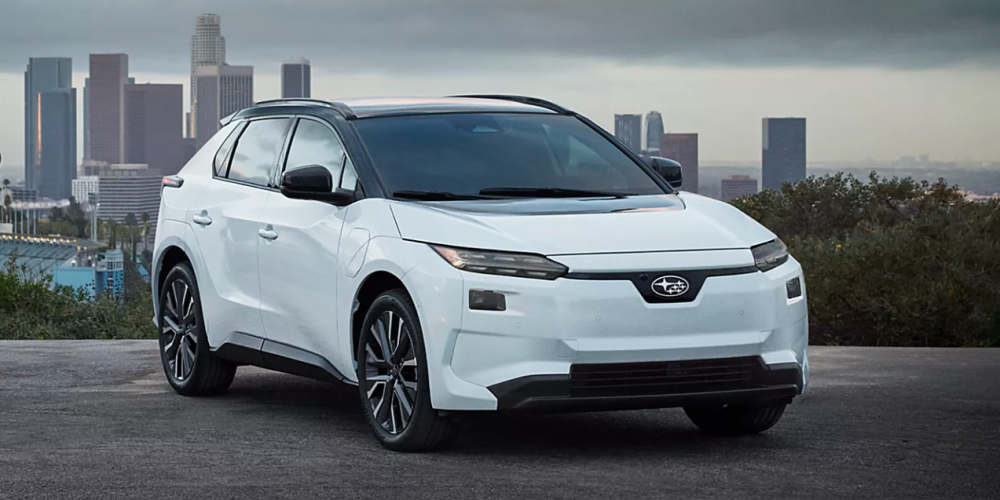
The U.S. 2027 Subaru Solterra offers a 74.7 kWh battery, an 11 kW onboard AC charger and DC charging up to 150 kW. Its NACS connection supports compatible home equipment and public fast chargers. This guide covers Premium, Limited, Limited XT and Touring XT, with a calculator for home charging and configuration-specific running costs.
Battery Capacity and Driving Range
Swipe horizontally to compare columns. The first column stays visible.
| U.S. trim | Published battery capacity | EPA range |
|---|---|---|
| Premium | 74.7 kWh | 288 miles |
| Limited | 74.7 kWh | 278 miles |
| Limited XT | 74.7 kWh | 278 miles |
| Touring XT | 74.7 kWh | 278 miles |
Source: Subaru U.S. 2027 specifications. Subaru labels 74.7 kWh as battery total power; a separate usable-capacity figure was not verified.
Published battery capacity and usable capacity are not always the same. A charging calculator based on the dashboard’s battery percentage needs the usable energy window. Subaru’s specification sheet provides 74.7 kWh but does not identify a separate usable value in the material reviewed here. Do not silently treat that figure as a verified net capacity.
Premium has the longest listed range. The other trims share a lower rating, so choosing an XT model does not imply a larger battery. Compare the exact configuration when considering operating costs.
Rated range is a standardized comparison. Cold weather, high speeds, cabin heating, roof-mounted equipment and cargo can change the distance between stops. For an unfamiliar route, use the vehicle’s arrival estimate and allow a reserve for another charging location.
What Charging Port Does the 2027 Solterra Use?
The 2027 model’s NACS connection changes which equipment connects directly compared with earlier Solterra models. Check the model year before following advice written for an older vehicle. Subaru’s 2027 charging features.
Swipe horizontally to compare columns. The first column stays visible.
| Setting | Charger output | Maximum used before losses |
|---|---|---|
| 32A | 7.68 kW | 7.68 kW |
| 40A | 9.60 kW | 9.60 kW |
| 48A | 11.52 kW | 11 kW vehicle limit |
Calculated at 240V, assuming the installation supports the selected current. Subaru specifies an 11 kW onboard AC charger. Actual voltage, settings and conditions affect delivered power.
A native-NACS home charger provides a direct connection. An existing J1772 charger may remain useful with the correct AC adapter. Check the adapter instructions, supported current and equipment compatibility before using that arrangement.
At a Tesla Supercharger or another NACS fast charger, confirm that the specific location supports your vehicle. A matching connector does not establish access to every station. Use current vehicle or network station information when planning a trip.
AC Charging Time Calculator
Select the U.S. 2027 Solterra and your trim, then set starting and target charge percentages. Compare charger settings over the same charge window. Your usual daily recharge may be much smaller than a 20%–80% top-up.
The result should account for usable capacity, charging losses and the lower of charger output and vehicle acceptance. Check the efficiency assumption displayed by the calculator. The vehicle’s live completion estimate can change with battery temperature and available power.
Level 1: Small Top-Ups at 120V
A compatible charging unit on a suitable household outlet can replenish a small amount of energy while the SUV remains parked for a long period. It is less practical for replacing a large part of the battery. Compare your daily driving needs with the energy available during your parking hours rather than relying on a fixed miles-per-hour charging claim.
Level 2: Home Charging at 240V
Swipe horizontally to compare columns. The first column stays visible.
| Equipment | Connection to vehicle | Use |
|---|---|---|
| Compatible NACS AC charger | Direct NACS | Home or destination AC charging |
| J1772 AC charger | J1772-to-NACS adapter | Use the specified AC adapter |
| Supported NACS DC charger | Direct NACS | Confirm station access |
| CCS1 DC charger | CCS1-to-NACS adapter | Use the specified DC adapter |
Subaru lists J1772-to-NACS and CCS1-to-NACS adapters as standard equipment. See 2027 specifications and charging features. AC and DC adapters are not interchangeable.
A 48A charger can provide more power than this vehicle accepts at 240V. Its higher equipment rating does not raise the Solterra’s onboard limit. A 32A or 40A setup may cover your normal overnight top-up; additional output is useful when your charging window is shorter.
Choosing a Home Charger for the Solterra
When comparing a Level 2 home EV charger, consider a compatible NACS connection, adjustable current, cable reach and scheduling. Park the vehicle in its normal position when checking cable length, including any space needed for loading or walking around the car.
Have the electrical supply assessed for the intended installation and follow the equipment instructions. Match the configured current to the installed circuit. If your household has another EV, consider both vehicles’ charging schedules when deciding how much power is useful.
A time-of-use electricity plan may make overnight charging cheaper. Check that the lower-price period is long enough for the energy you need; a session that extends into a more expensive period will have a blended cost.
DC Fast Charging: Up to 150 kW
Subaru lists a 150 kW DC maximum and a reference 10%–80% charging time of approximately 28 minutes. Battery preconditioning helps prepare the battery for charging in different temperatures. Follow the vehicle’s instructions for using it. Subaru charging overview; rated DC power.
Peak charging power is not maintained throughout the stop. Starting charge, battery temperature and station output affect the charging curve. A station rated above 150 kW does not make the Solterra exceed its own limit.
For road trips, charge enough to reach the next suitable stop with a reserve. Charging closer to full can take longer per percentage point. Check the session estimate and allow for queues or a station being unavailable.
EPA Energy Use and Home Charging Costs
Swipe horizontally to compare columns. The first column stays visible.
| EPA configuration | Combined MPGe | kWh/100 miles | Cost/100 miles |
|---|---|---|---|
| Solterra AWD | 120 | 28 | $4.76 |
| Solterra 20 AWD | 117 | 29 | $4.93 |
Source: 2027 EPA listings. Costs use the displayed rounded energy figures and an illustrative $0.17/kWh household rate. The 20 AWD entry identifies the 20-inch-wheel configuration.
Multiply the electricity-use figure by your own price per kWh. The example rate is not a claimed national average. EPA electricity consumption includes charging losses, so no second loss factor is added to these cost estimates. Fixed utility fees, installation and charger purchase are excluded.
Use the actual tariff for your charging hours. For a public session, calculate from the energy billed by the station. For example, 40 kWh at an illustrative $0.45/kWh costs $18 before any additional fees. This is a session example rather than a full-battery price.
Frequently Asked Questions
Does the XT have a larger battery?
Subaru lists the same 74.7 kWh capacity for all four trims. Higher motor performance does not imply a larger battery.
Can a 48A charger charge the Solterra at 11.52 kW?
That is the charger’s nominal output at 240V. The vehicle’s published 11 kW AC limit caps accepted power before charging losses are considered.
Can I use my existing J1772 equipment?
Subaru lists a J1772-to-NACS AC adapter among the standard charging equipment. Follow its instructions and check the equipment rating.
Is the 28-minute figure a home-charging time?
No. It describes the reference 10%–80% DC fast-charge session. Use the AC calculator for home-charging estimates.