
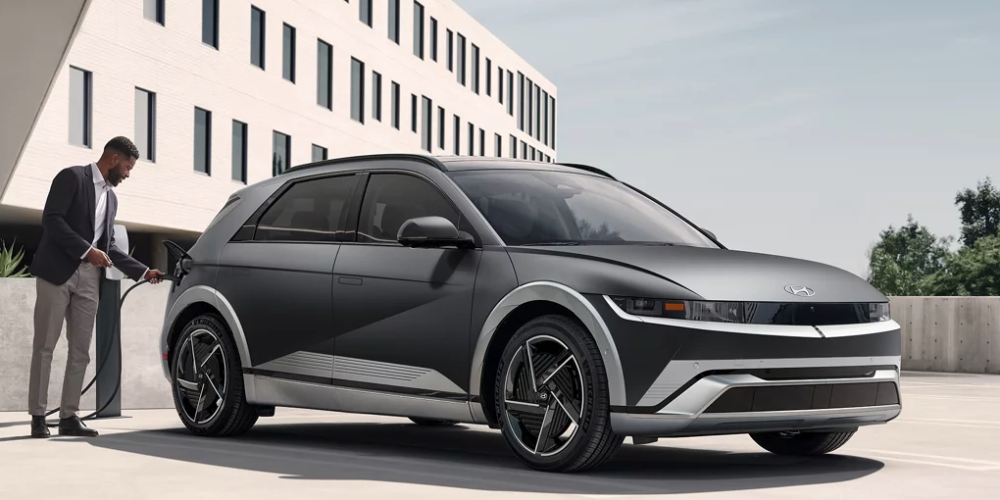
The 2027 IONIQ 5 combines a native NACS port with 63 or 84 kWh battery options. The fastest advertised stops depend on compatible high-voltage DC equipment; the connector alone does not determine charging speed.
This guide covers the U.S. SE Standard Range, SE, SEL, Limited and XRT. It does not apply these ratings to IONIQ 5 N or a robotaxi configuration.
Battery Capacity and Configuration
Swipe horizontally to compare columns. The first column stays visible.
| Configuration | Published capacity | Range / matching detail |
|---|---|---|
| SE Standard Range RWD | 63 kWh | 245 miles |
| SE / SEL / Limited RWD | 84 kWh | 318 miles |
| SE / SEL AWD | 84 kWh | 290 miles |
| Limited AWD | 84 kWh | 269 miles |
| XRT AWD | 84 kWh | 259 miles |
Hyundai labels 63 and 84 kWh as battery system capacity. A separate U.S. usable-capacity value was not verified. Its home-charging reference uses 10.9 kW at 240V; confirm the exact onboard specification and usable input when configuring the calculator.
Technical source; model-year information.
Usable energy describes the portion available within the battery’s operating window. That is the relevant input for a charging calculation based on dashboard percentage. Range multiplied by EPA consumption is not a reliable way to derive it, because EPA wall-energy consumption includes losses.
Charging Ports and Adapter Compatibility
Swipe horizontally to compare columns. The first column stays visible.
| Source | Connection guidance |
|---|---|
| NACS AC | Compatible direct home connection |
| J1772 AC | Approved AC adapter arrangement |
| NACS DC | Confirm vehicle/network support |
| CCS1 DC | Approved CCS1 DC adapter arrangement |
Use adapters approved for the vehicle and purpose. AC and DC adapters are not interchangeable. Model information.
Check the inlet on the actual vehicle before purchasing equipment. A connector adapter changes the physical connection; it does not guarantee vehicle approval, network access or a particular charging speed. Confirm the station in the vehicle or manufacturer charging tools before relying on a stop.
AC Charging Time Calculator
Select the correct model year, battery and drivetrain, then set starting and target charge percentages. Compare charger settings over the same charge window. A daily commute may need a much smaller top-up than 20%–80%.
The estimate should use the lower of available charger power and vehicle acceptance, with the calculator’s efficiency assumption applied separately. Temperature, available voltage and vehicle settings can change the actual finish time.
Level 1 or Level 2?
A compatible portable unit on a suitable 120V outlet can provide small top-ups during long parking periods. Replacing a substantial portion of the battery is much slower. Compare the energy you use each day with the energy that can be delivered during your parking hours.
Level 2 uses a suitable 240V supply and is more practical for larger overnight recharges. It does not require charging from empty to full every night: choose a target suited to your next journey and the vehicle’s current recommendations.
Swipe horizontally to compare columns. The first column stays visible.
| Setting | Nominal EVSE output | Vehicle-limited reference |
|---|---|---|
| 32A | 7.68 kW | 7.68 kW |
| 40A | 9.60 kW | 9.60 kW |
| 48A | 11.52 kW | 10.90 kW |
Calculated before charging losses. Supply voltage and vehicle equipment must match these assumptions. Technical source; model-year information.
For XRT owners, plan with the XRT-specific rating rather than the longer-range RWD figure. All-terrain equipment and drivetrain differences affect trip energy needs even when battery capacity is shared.
Choosing a Home Charger
When comparing a Level 2 home EV charger, prioritize the correct connection, adjustable current, cable reach and scheduling. Higher rated output is useful only when the vehicle and installation can support it.
Measure cable reach with the vehicle parked normally. Consider access to the charging flap and space needed for passengers or loading. Have the electrical installation assessed for the intended current and follow the charger instructions.
If your utility has cheaper overnight hours, check whether that window covers your normal recharge. For two EVs, compare both vehicles’ schedules and daily energy needs before deciding how much equipment to install.
DC Fast Charging
Hyundai’s 2027 table gives a 10%–80% reference of 20 minutes on suitable 800V equipment through the CCS adapter. For 150 kW, 400V NACS equipment, it lists 24 minutes for Standard Range and 30 minutes for the larger battery. These are equipment-specific reference conditions, not universal Tesla Supercharger timings. The 350 kW equipment rating in the overview is not the vehicle’s peak acceptance.
Technical source; model-year information.
Peak power is not maintained throughout a session. Battery temperature, starting charge and station conditions affect the charging curve. Follow the vehicle’s preparation guidance and check the live estimate after connecting.
For a journey, charge enough to reach the next suitable stop with a reserve. Charging close to full can take longer per percentage point. Allow for a station being occupied or unavailable, especially on routes with few alternatives.
EPA Energy Use and Charging Costs
Swipe horizontally to compare columns. The first column stays visible.
| EPA configuration | MPGe | kWh/100 mi | Cost/100 mi |
|---|---|---|---|
| Standard Range | 115 | 29 | $4.93 |
| RWD | 114 | 30 | $5.10 |
| AWD — 19-inch | 106 | 32 | $5.44 |
| AWD — 20-inch | 98 | 34 | $5.78 |
| AWD XRT | 94 | 36 | $6.12 |
EPA listings. Costs use an illustrative $0.17/kWh rate and rounded displayed consumption. Entries apply to the named configurations only.
Multiply your configuration’s electricity-use rating by the price per kWh during charging. The example tariff is not a national-average claim. EPA consumption already includes charging losses, so no additional loss factor is added to these costs.
These figures cover electricity only. Charger purchase, installation and fixed utility fees are excluded. Driving at high speed, cold weather, cargo and towing can increase real-world consumption.
Public Charging Costs
Use the energy billed by the station and its tariff. For example, a session billing 40 kWh at an illustrative $0.45/kWh costs $18 before parking, idle or other fees. This is not a full-battery price or a guaranteed driving distance.