
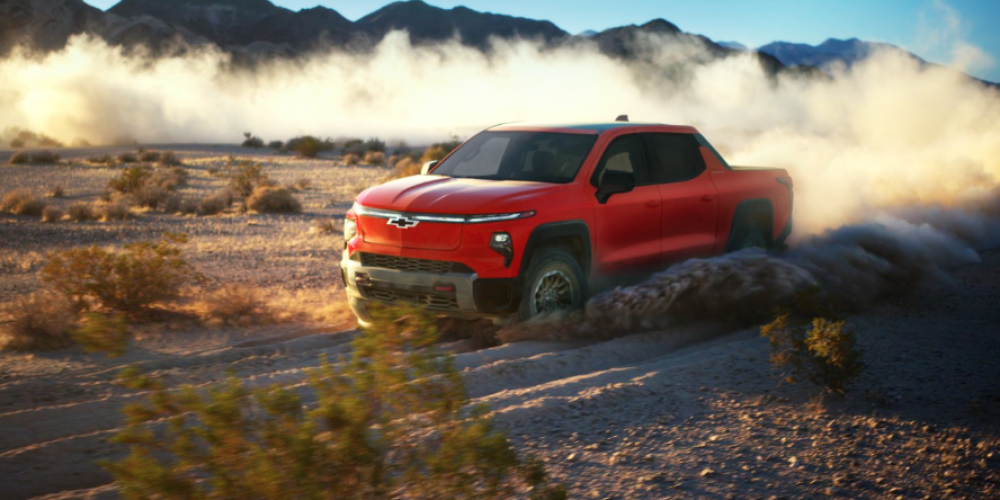
The U.S. 2026 Silverado EV offers Standard, Extended and Max Range batteries. Its J1772 AC and CCS1 DC connection, installed onboard charger and battery option determine which charging equipment can be used and how quickly energy can be added.
This guide covers the 2026 U.S. WT, LT and Trail Boss lineup. Match the battery and charging equipment on your vehicle rather than applying one configuration’s range or charging rating to every truck.
Battery Capacity and Configuration
Swipe horizontally to compare columns. The first column stays visible.
| Battery option | Reported capacity* | Peak DC capability |
|---|---|---|
| Standard Range | 119 kWh (dealer-reported) | Up to 220 kW |
| Extended Range | 170 kWh (dealer-reported) | Up to 300 kW |
| Max Range | 205 kWh (dealer-reported) | Up to 350 kW |
The capacities above are dealer-reported reference figures, not a verified Chevrolet gross/usable capacity specification. Hamburg Chevrolet lists 119 kWh for Standard Range and 170 kWh for Extended Range; Modern Chevrolet of Burlington describes the Max Range pack as 205 kWh. The reviewed Chevrolet technical release confirms the three pack categories and their DC limits, but does not publish their kWh capacities. Do not enter these figures as confirmed usable energy in the calculator without checking the exact vehicle.
Capacity references: Hamburg Chevrolet and Modern Chevrolet of Burlington. The sources do not establish a consistent gross-versus-usable definition.
Chevrolet’s 2026 release lists EPA range of 286 miles for WT Standard Range and 283 for LT Standard Range; WT Extended Range reaches 424 miles, versus 410 for LT and Trail Boss Extended Range. WT Max Range is listed at 493 EPA miles. Its 478-mile LT and Trail Boss Max Range figures are labeled GM estimates in that release. Wheels, equipment and the exact EPA entry still matter.
Technical source; model-year information.
Usable energy describes the portion available within the battery’s operating window. That is the relevant input for a charging calculation based on dashboard percentage. Range multiplied by EPA consumption is not a reliable way to derive it, because EPA wall-energy consumption includes losses.
Charging Ports and Adapter Compatibility
Swipe horizontally to compare columns. The first column stays visible.
| Source | Connection guidance |
|---|---|
| J1772 AC | Direct compatible connection |
| CCS1 DC | Direct compatible connection |
| NACS DC | GM-approved NACS DC adapter at supported stations |
Use adapters approved for the vehicle and purpose. AC and DC adapters are not interchangeable. Model information.
The 2026 truck uses CCS1 for fast charging, with J1772 for AC charging. Tesla Supercharger use requires compatible stations, account activation and the GM-approved NACS DC adapter. That DC adapter is not for a NACS home charger. 2026 connector reference.
Check the inlet on the actual vehicle before purchasing equipment. A connector adapter changes the physical connection; it does not guarantee vehicle approval, network access or a particular charging speed. Confirm the station in the vehicle or manufacturer charging tools before relying on a stop.
AC Charging Time Calculator
Select the correct model year, battery and drivetrain, then set starting and target charge percentages. Compare charger settings over the same charge window. A daily commute may need a much smaller top-up than 20%–80%.
The estimate should use the lower of available charger power and vehicle acceptance, with the calculator’s efficiency assumption applied separately. Temperature, available voltage and vehicle settings can change the actual finish time.
Level 1 or Level 2?
A compatible portable unit on a suitable 120V outlet can provide small top-ups during long parking periods. Replacing a substantial portion of the battery is much slower. Compare the energy you use each day with the energy that can be delivered during your parking hours.
Level 2 uses a suitable 240V supply and is more practical for larger overnight recharges. It does not require charging from empty to full every night: choose a target suited to your next journey and the vehicle’s current recommendations.
Swipe horizontally to compare columns. The first column stays visible.
| Setting | Nominal EVSE output | Vehicle-limited reference |
|---|---|---|
| 32A | 7.68 kW | 7.68 kW |
| 40A | 9.60 kW | 9.60 kW |
| 48A | 11.52 kW | 11.50 kW |
Calculated before charging losses. Supply voltage and vehicle equipment must match these assumptions. Technical source; model-year information.
Depending on equipment, the truck has an 11.5 or 19.2 kW onboard AC charger. The table uses the 11.5 kW version. At 48A and 240V, a 19.2 kW-equipped truck is still limited to approximately 11.52 kW by the home unit. Reaching 19.2 kW requires suitable 80A charging equipment and installation. Confirm the onboard module on the factory vehicle specification; offboard power output is a separate rating.
Chevrolet’s U.S. 2026 vehicle equipment listing identifies the onboard charging modules; verify the selected vehicle’s equipment before configuring the calculator.
For regular towing, plan with the energy actually used while towing and the time available at home. Trailer aerodynamics and load can substantially change consumption. A larger pack stores more energy, but it does not reduce the energy that must be replaced after a trip.
Choosing a Home Charger
When comparing a Level 2 home EV charger, prioritize the correct connection, adjustable current, cable reach and scheduling. Higher rated output is useful only when the vehicle and installation can support it.
Measure cable reach with the vehicle parked normally. Consider access to the charging flap and space needed for passengers or loading. Have the electrical installation assessed for the intended current and follow the charger instructions.
If your utility has cheaper overnight hours, check whether that window covers your normal recharge. For two EVs, compare both vehicles’ schedules and daily energy needs before deciding how much equipment to install.
DC Fast Charging
Chevrolet specifies peak DC capability of 220 kW for Standard Range, 300 kW for Extended Range and 350 kW for Max Range. The battery option therefore matters when planning fast-charging stops. These are peak capabilities, not average charging rates or guaranteed station output. A single 10%–80% time is not assigned to all three packs.
Technical source; model-year information.
Peak power is not maintained throughout a session. Battery temperature, starting charge and station conditions affect the charging curve. Follow the vehicle’s preparation guidance and check the live estimate after connecting.
For a journey, charge enough to reach the next suitable stop with a reserve. Charging close to full can take longer per percentage point. Allow for a station being occupied or unavailable, especially on routes with few alternatives.
EPA Energy Use and Charging Costs
Swipe horizontally to compare columns. The first column stays visible.
| EPA configuration | MPGe | kWh/100 mi | Cost/100 mi |
|---|---|---|---|
| Extended Range WT | 70 | 48 | $8.16 |
| Max Range WT — 19kW Charger | 68 | 49 | $8.33 |
| Extended Range — 11kW Charger | 68 | 50 | $8.50 |
| Extended Range — 19kW Charger | 64 | 52 | $8.84 |
| Standard Range WT — 11kW Charger | 68 | 50 | $8.50 |
| Standard Range — 11kW Charger | 67 | 50 | $8.50 |
EPA listings. Costs use an illustrative $0.17/kWh rate and rounded displayed consumption. Entries apply to the named configurations only.
Multiply your configuration’s electricity-use rating by the price per kWh during charging. The example tariff is not a national-average claim. EPA consumption already includes charging losses, so no additional loss factor is added to these costs.
These figures cover electricity only. Charger purchase, installation and fixed utility fees are excluded. Driving at high speed, cold weather, cargo and towing can increase real-world consumption.
Public Charging Costs
Use the energy billed by the station and its tariff. For example, a session billing 40 kWh at an illustrative $0.45/kWh costs $18 before parking, idle or other fees. This is not a full-battery price or a guaranteed driving distance.