
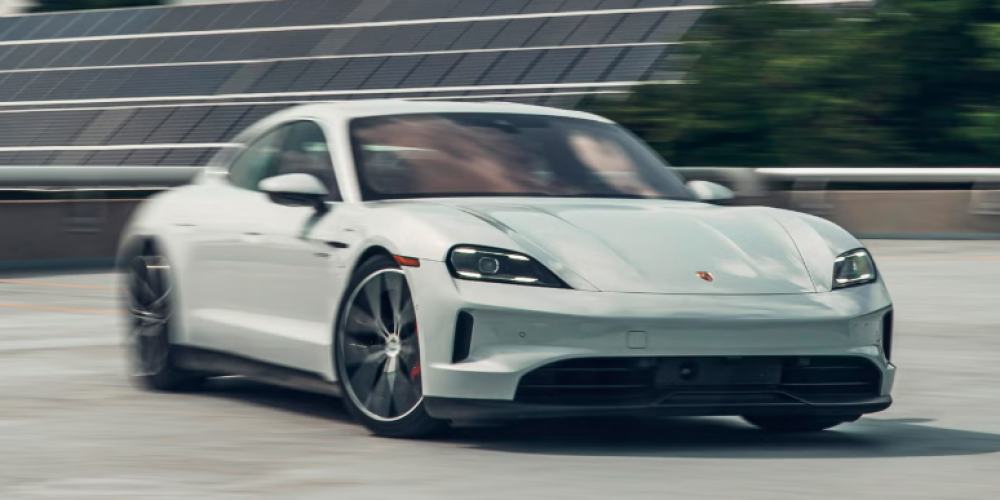
The U.S. 2027 Porsche Taycan has a charging arrangement worth checking before buying home equipment: J1772 for AC on the driver’s side and a native NACS DC port on the passenger’s side. Porsche also makes the 105 kWh Performance Battery Plus standard across the U.S. range. Porsche’s 2027 announcement.
This guide explains battery capacity, home charging, fast charging and selected EPA energy-use ratings. Match the model, body style, wheel configuration and onboard charging equipment to your own vehicle.
Battery Capacity and Charging Specifications
Swipe horizontally to compare columns. The first column stays visible.
| Specification | Published value | Scope |
|---|---|---|
| Performance Battery Plus, gross | 105 kWh | Standard across U.S. 2027 variants |
| Net usable energy | 97 kWh | Verified in the 2027 Taycan 4 listing |
| AC onboard charger | 9.6 kW | Equipment listed for the verified Taycan 4 |
| Peak DC power | 320 kW | Compatible high-voltage DC equipment |
| DC 10%–80% reference | 18 minutes | Maximum-power reference, suitable conditions |
Sources: Porsche U.S. model-year announcement and 2027 Taycan 4 equipment and technical data. Confirm exact vehicle equipment before assigning AC limits to other variants.
Gross capacity includes energy outside the normal usable window. For a charging calculator based on displayed battery percentage, use the verified usable capacity. The official 2027 Taycan 4 listing distinguishes 105 kWh gross from 97 kWh net; do not enter the gross value as usable energy.
Before enabling a different trim in the calculator, confirm its usable capacity and onboard charger. A specification for a European vehicle or an older model year should not automatically be applied to a U.S. 2027 car.
Which Charging Port Should You Use?
Swipe horizontally to compare columns. The first column stays visible.
| EVSE setting | Nominal EVSE power | Vehicle-limited power |
|---|---|---|
| 32A | 7.68 kW | 7.68 kW |
| 40A | 9.60 kW | 9.60 kW |
| 48A | 11.52 kW | 9.60 kW |
Calculated before charging losses. This comparison applies to a car equipped with the 9.6 kW onboard charger; verify the equipment on your own Taycan.
For home charging, start with the driver-side J1772 AC connection. The new NACS DC inlet does not, by itself, make a NACS home charger a direct-match purchase. Verify any proposed adapter arrangement against Porsche’s guidance for the exact car.
For public DC charging, check the station’s supported vehicles and connector before setting off. Native NACS reduces the need for an adapter at compatible NACS fast chargers, but does not guarantee that every location is accessible or can deliver the Taycan’s maximum charging power.
AC Charging Time Calculator
Select model year 2027 and the matching configuration. Set your starting and target battery percentages, then compare current settings over the same charge window. A routine daily top-up is often much smaller than a 20%–80% session.
he estimate should use the lower of available EVSE power and the vehicle’s AC acceptance, with charging efficiency applied separately. Available voltage, battery temperature and vehicle settings can change the actual completion time.
Level 1 Charging
A compatible charging unit connected to a suitable 120V outlet can provide small top-ups during long parking periods. Replacing a substantial portion of this battery requires much more time. Check whether the energy delivered during your available hours covers your daily driving rather than assuming a fixed number of miles gained per hour.
Level 2 Charging
Swipe horizontally to compare columns. The first column stays visible.
| Charging equipment | Vehicle connection | Important distinction |
|---|---|---|
| J1772 home / public AC charger | Driver-side J1772 AC port | Direct compatible AC connection |
| NACS DC fast charger | Passenger-side NACS DC port | Confirm location and vehicle access |
| CCS1 DC fast charger | NACS DC port via specified CCS adapter | Use Porsche-approved DC equipment |
| NACS AC home charger | Compatibility requires separate verification | Do not assume the NACS DC port accepts AC |
Source: Porsche’s U.S. 2027 interface announcement. A CCS DC adapter is listed on the verified Taycan 4. AC and DC connections serve different purposes.
With the verified 9.6 kW onboard charger, moving from 40A to 48A at 240V does not increase accepted AC power. A higher-rated home charger can still offer other useful features, but its advertised output is not a promise that this car will charge faster.
Choosing a Home Charger for the Taycan
When comparing a Level 2 home EV charger, prioritize the correct J1772 AC connection, adjustable current, cable reach and scheduling. Confirm the vehicle’s onboard charger before paying for more output solely to reduce charging time.
Check cable reach with the car parked normally and with access to the driver-side charging flap. Have the electrical installation assessed for the intended current and follow the equipment instructions. The selected charging current must match the installed supply.
If your utility offers cheaper overnight hours, compare that window with the top-up you need. For a two-EV household, consider both vehicles’ parking and charging schedules when choosing equipment.
DC Fast Charging: Peak Power and Stop Duration
The verified 2027 Taycan 4 technical data gives a peak of 320 kW and an 18-minute reference for 10%–80% at maximum charging power. These are different measures: peak output is not maintained throughout the session. Compatible high-voltage equipment and suitable battery conditions matter. Porsche technical data.
A native NACS connector does not guarantee the 18-minute result. Station voltage, available current, battery temperature and starting charge all affect performance. Use the vehicle’s charging preparation guidance and check the live estimate after connecting.
For a journey, charge enough for the next leg and an appropriate reserve. Charging close to full generally takes longer per percentage point, so the fastest trip plan may use shorter stops rather than filling to 100% every time.
EPA Range, Energy Use and Home Costs
Wheel and tire details can materially affect the rating. For example, EPA lists the Taycan 4 Performance Battery Plus at 294 miles, while its separately listed 19-inch all-season configuration reaches 315 miles. Use the full EPA entry rather than treating those figures as interchangeable. Taycan 4 EPA entry; 19-inch all-season entry.
Swipe horizontally to compare columns. The first column stays visible.
| EPA configuration | Combined MPGe | kWh/100 mi | Cost/100 mi |
|---|---|---|---|
| Taycan 4 Perf Battery Plus | 87 | 39 | $6.63 |
| Taycan 4 Perf Battery Plus — 19in All Season | 93 | 36 | $6.12 |
| Taycan 4S Perf Battery Plus | 87 | 39 | $6.63 |
| Taycan 4S Perf Battery Plus — 19in All Season | 93 | 36 | $6.12 |
| Taycan 4S Cross Turismo | 80 | 42 | $7.14 |
| Taycan GTS | 86 | 39 | $6.63 |
| Taycan Turbo | 86 | 39 | $6.63 |
| Taycan Turbo GT | 82 | 41 | $6.97 |
| Taycan Turbo S | 79 | 43 | $7.31 |
Source: EPA 2027 listings, checked November 26, 2026. Selected published entries, not a complete orderable-model list. Costs use an illustrative $0.17/kWh rate.
Multiply the displayed electricity consumption by your charging-hour tariff. EPA consumption includes charging losses, so a second loss allowance is not added here. The example costs exclude equipment, installation and fixed utility fees.
The table does not substitute sedan ratings for Cross Turismo versions. If your exact configuration is absent, use its own EPA listing or window label rather than selecting the nearest model name.
Public Charging Cost
Use the energy billed by the station and its tariff. A session billing 50 kWh at an illustrative $0.45/kWh costs $22.50 before other fees. This is a session example, not a full-battery cost. Membership, parking or idle fees can change the final amount.