
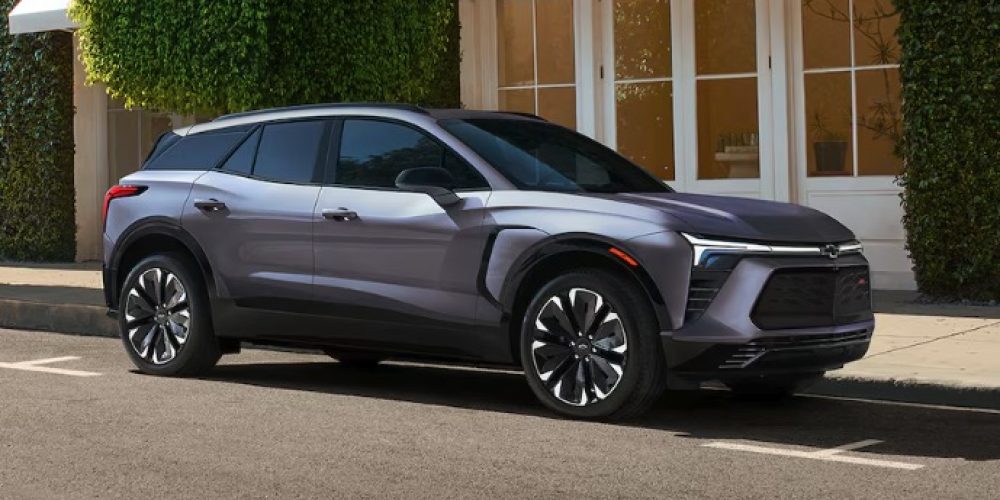
The 2027 Chevy Blazer EV is an all-electric SUV with several home and public charging options. Charging time depends on the battery, charging equipment, starting charge level, and battery conditions. This guide explains AC home charging, DC fast charging, connector compatibility, and estimated charging costs.
Updated November 12, 2026: The comparison below covers three representative U.S. 2027 retail configurations: LT/RS FWD, LT/RS AWD, and SS AWD. Earlier model years and wheel/tire options can have different specifications. PPV models are excluded.
Chevy Blazer EV Battery, Charging Port, and Charging Power
For the 2027 model year, LT and RS are offered with FWD or AWD, while SS uses AWD. The comparison below groups them by powertrain: LT/RS FWD, LT/RS AWD, and SS AWD. Their EPA ranges are 312, 283, and 302 miles, respectively.
GM lists rated battery energy of 85 kWh for LT/RS and 102 kWh for SS. All three configurations support up to 11.5 kW AC charging. Peak DC capability is up to 150 kW for LT/RS and 190 kW for SS.
Wheel and tire choices can change EPA range. For example, the separately rated FWD 22-inch-tire version has a 283-mile rating.
Three representative U.S. 2027 retail powertrain configurations.
Swipe horizontally to compare all columns. The first column stays visible.
| Specification | LT/RS FWD | LT/RS AWD | SS AWD |
|---|---|---|---|
| EPA range (miles) | 312 | 283 | 302 |
| Rated battery energy (kWh) | 85 | 85 | 102 |
| AC onboard capability (kW) | 11.5 | 11.5 | 11.5 |
| DC peak capability (kW) | 150 | 150 | 190 |
| EPA consumption (kWh/100 miles) | 32 | 36 | 40 |
The U.S. 2027 Blazer EV has a native NACS port. U.S. 2024–2026 models use CCS1/J1772.
The comparison uses the listed EPA powertrain ratings. Wheel/tire options have separate ratings; the EPA 2027 FWD 22-inch-tire version is rated at 283 miles rather than 312 miles. PPV is excluded.
85/102 kWh are GM rated battery energy, not independently verified usable energy. All three configurations have 11.5 kW AC capability.
Sources: Chevrolet 2027 Blazer EV; GM 2027 order guide, pp. 9 and 39 (manufacturer document mirror); EPA FWD; EPA AWD; EPA SS AWD.
The U.S. 2027 Blazer EV uses a native NACS (J3400) charging port for AC and DC charging. U.S. 2024–2026 models use J1772 for AC charging and CCS1 for DC fast charging.
When a 2027 vehicle uses a J1772 AC charger, it needs the appropriate J1772 AC adapter. A CCS1 DC station requires the appropriate CCS1 DC adapter. AC and DC adapters are different products; use the GM-approved adapter for the vehicle and charging type.
Can the Blazer EV Use Tesla Superchargers?
The 2027 Blazer EV can connect directly at compatible Tesla Superchargers open to GM vehicles. U.S. 2024–2026 vehicles need the appropriate NACS-to-CCS1 DC adapter, unless the selected station provides a compatible Magic Dock adapter.
Check station compatibility and pricing in the myChevrolet app or supported charging app before arrival. For earlier CCS1 models, see our NACS-to-CCS1 adapter guide.
Charging Time by Charger Types
Use the AC charging calculator below to estimate home charging time. Select your Blazer EV model year and configuration, enter your starting and target battery levels, and choose the charging output available at home.
The calculator covers AC home charging; use the separate DC reference below for fast charging.
AC estimates use modeled charging efficiencies of 90% for Level 1 and 92% for Level 2, with a 1.5× time allowance for the portion above 80% charge. The published 85 or 102 kWh rated battery energy is used as a calculation proxy rather than verified usable capacity. These are planning assumptions, not measured charging curves. EPA-based range and cost comparisons already include AC charging losses and do not add a second loss factor.
Level 1 Charging (120V, NEMA 5-15)
Level 1 charging at 120 V and 12 A provides about 1.44 kW before charging losses. It can work for modest daily top-ups or backup charging, but recovering a large part of the battery takes considerable time. Whether it meets daily needs depends on mileage, weather, and time plugged in.
Use a suitable grounded outlet and follow the charging equipment’s instructions. Cold weather and the vehicle’s own energy use can reduce the energy available to charge the battery. Use the calculator for your chosen charge levels instead of a single full-charge estimate.
Level 2 Charging (240V)
Level 2 charging is the practical option for most home charging. A 48 A hardwired EVSE at 240 V supplies up to 11.52 kW, while these Blazer EV configurations accept up to 11.5 kW. A 40 A EVSE supplies up to 9.6 kW.
A higher-rated EVSE will not raise the vehicle’s 11.5 kW AC limit. Lower-output equipment can still suit smaller daily energy needs, with longer charging times.
Use the calculator to compare available outputs and have a qualified electrician assess the circuit and electrical capacity.
DC Fast Charging (Up to 150–190 kW)
DC fast charging is useful for road trips and quick public charging stops. For the 2027 Blazer EV, peak DC capability is up to 150 kW for LT/RS configurations and 190 kW for SS.
2027 charging power and separately labeled 2026 manufacturer timing references.
Swipe horizontally to compare all columns. The first column stays visible.
| Model year and measure | Reference |
|---|---|
| 2027 confirmed peak DC capability | |
| 2027 LT/RS FWD | Up to 150 kW |
| 2027 LT/RS AWD | Up to 150 kW |
| 2027 SS AWD | Up to 190 kW |
| 2026 manufacturer timing references | |
| 2026 lineup: 10%–80% | Approximately 39 minutes |
| 2026 FWD: range added in 10 minutes | Up to 83 miles |
| 2026 AWD: range added in 10 minutes | Up to 75 miles |
Peak power is not the average power of a charging session. Battery temperature, starting charge level, station output and power sharing affect results.
The 2026 time and range-gain figures are prior-model-year references. They are not confirmed 2027 results for every configuration. The 75-mile AWD statement is not presented here as a separate SS test.
No 2027 full-session duration is calculated from a fixed percentage of peak power. No 0%–100% DC duration or linear 30-/100-mile time is claimed.
Sources: GM 2027 order guide; Chevrolet 2026 Blazer EV FAQs.
For a manufacturer timing reference, Chevrolet’s 2026 Blazer EV page quotes approximately 39 minutes from 10% to 80%, plus up to 83 miles added in 10 minutes for FWD or 75 miles for AWD. These are 2026 references, not confirmed results for every 2027 configuration.
Peak power is not sustained throughout a session. Battery temperature, starting charge level, station output, and power sharing affect the result. Charging slows as the battery fills, so use the vehicle or charging app’s estimate when planning a stop.
Factors That Affect Charging Time
Beyond battery size and charger type, the following factors influence charging time:
- Battery temperature: A cold or very hot battery can limit charging power. Use the vehicle’s available charging-preparation features when planning a fast-charging stop.
- State of charge: DC charging power changes across the session and generally falls as the battery fills. AC charging can also take longer near full charge.
- Charger output: The station, electrical supply, vehicle limit, adapter rating, and power sharing can restrict available power.
- Energy use during charging: Cabin heating, air conditioning, and battery conditioning can reduce the net energy added to the battery.
How to Choose the Right EV Charger
Choose charging equipment that matches your daily driving, the vehicle’s charging limit, and your home electrical supply.
- Home charging convenience: A 48 A hardwired Level 2 home charger is a good match for the 11.5 kW AC limit. Ask an electrician to assess the installation.
- Portable charging: A Level 1 & Level 2 portable EV charger with output up to 40 A can add flexibility where a suitable outlet is available. At 240 V and 40 A, output is up to 9.6 kW.
- Charging speed versus cost: Choose the output that fits your daily driving and electrical supply. Equipment rated above 11.5 kW will not make these vehicles charge faster on AC.
For a 2027 Blazer EV, choose a compatible NACS AC connector or use a GM-approved J1772 AC adapter with a J1772 charger. U.S. 2024–2026 models connect directly to compatible J1772 AC chargers. Keep output within the limits of the vehicle, charger, adapter, and installation.
Charging Cost for the Chevy Blazer EV
Home Charging Cost
At an illustrative home electricity rate of $0.1816/kWh, the three 2027 configurations cost approximately $5.81, $6.54, and $7.26 per 100 miles, respectively.
The comparison uses EPA combined consumption, which includes AC charging losses, so no additional efficiency factor is applied.
U.S. 2027 configurations. Illustrative residential electricity rate: $0.1816/kWh.
Swipe horizontally to compare all columns. The first column stays visible.
| Blazer EV configuration | EPA consumptionkWh/100 miles | Electricity rate$/kWh | Cost per mileestimated $ | Cost per 100 milesestimated $ |
|---|---|---|---|---|
| LT/RS FWD | 32 | $0.1816 | $0.058 | $5.81 |
| LT/RS AWD | 36 | $0.1816 | $0.065 | $6.54 |
| SS AWD | 40 | $0.1816 | $0.073 | $7.26 |
Rate: EIA August 2026 preliminary U.S. residential average, released October 23, 2026. Your tariff, taxes and other charges may differ.
EPA consumption includes AC charging losses. No extra efficiency adjustment is applied. Cost per 100 miles = EPA kWh per 100 miles × electricity rate.
Sources: EIA electricity prices; EPA FWD; EPA AWD; EPA SS AWD.
Rate reference: EIA August 2026 preliminary U.S. residential average, released October 23, 2026. Your household tariff, taxes, and other charges may differ.
Public DC Fast-Charging Cost
For a public DC comparison, an illustrative rate of $0.533/kWh gives estimated costs of $17.06, $19.19, and $21.32 per 100 miles for the FWD, AWD, and SS AWD configurations.
The rate is Paren’s Q3 2026 U.S. non-Tesla fast-charging average, excluding free charging.
U.S. 2027 configurations. Illustrative public DC rate: $0.533/kWh.
Swipe horizontally to compare all columns. The first column stays visible.
| Blazer EV configuration | EPA consumptionkWh/100 miles | Electricity rate$/kWh | Cost per mileestimated $ | Cost per 100 milesestimated $ |
|---|---|---|---|---|
| LT/RS FWD | 32 | $0.533 | $0.171 | $17.06 |
| LT/RS AWD | 36 | $0.533 | $0.192 | $19.19 |
| SS AWD | 40 | $0.533 | $0.213 | $21.32 |
Price reference: Paren Q3 2026 U.S. non-Tesla fast-charging average, excluding free charging. This is a market benchmark, not a uniform price for all stations or connectors.
EPA AC consumption is a common energy proxy for comparison, not measured DC energy billed. Actual costs vary with efficiency, station, time and membership. Extra taxes, session and idle fees are excluded.
Source: Paren Q3 2026 report. Check the charging app for the selected station’s current price, including Tesla Superchargers.
EPA AC consumption is used as a common energy proxy, not measured DC energy billed. Actual costs depend on efficiency, station pricing, location, time, and membership. Extra taxes, session fees, and idle fees are excluded.
Check the selected charging station in the app for the current price, including Tesla Superchargers.
Conclusion
The Chevy Blazer EV supports up to 11.5 kW AC charging, with peak DC capability of up to 150 kW for LT/RS or 190 kW for SS. A suitable Level 2 setup makes routine home charging convenient, while a portable charger can provide backup flexibility.
Choose the correct model year and configuration in the AC calculator. The U.S. 2027 Blazer EV uses NACS, while U.S. 2024–2026 models use J1772/CCS1. Match the connector or approved adapter to the vehicle, and check station compatibility, charging conditions, and local prices before a trip.