
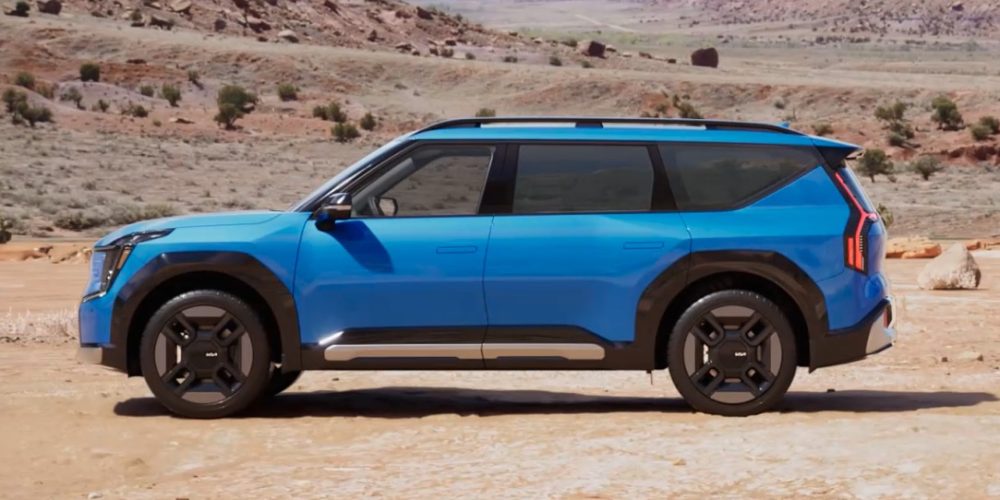
The Kia EV9 is an all-electric SUV designed for families and long-distance travel, offering several battery and drivetrain configurations. This guide covers its charging ports, home charging, DC fast charging, costs, and Tesla Supercharger compatibility.
Updated November 13, 2026: The comparison includes available 2027 EPA range and energy-consumption ratings. Battery and charging specifications retain their published 2026 reference year where identified. Check the model year and equipment fitted to your vehicle.
Charging Ports & Power Capabilities
U.S. 2024–2025 EV9 models use J1772 for AC charging and CCS1 for DC fast charging. The U.S. 2026 EV9 has a native NACS charging port. Match the connector to your actual vehicle before choosing a charger or adapter.
A native-NACS EV9 needs the appropriate Kia-approved J1772 AC adapter for a J1772 home charger, or a Kia-approved CCS1 DC adapter for a CCS1 fast charger. These adapters serve different charging purposes.
Kia’s published 2026 specifications list a 76.1 kWh battery for Light RWD and 99.8 kWh for the longer-range versions. The AC charging limit is 10.9 kW. Published peak DC power is 235 kW for Light RWD and 210 kW for the 99.8 kWh versions.
A station marked “350 kW” does not make the vehicle accept 350 kW. The station, battery and vehicle charging limits determine the power available during a session.
2027 EPA categories with separately labeled 2026 battery and charging references.
Swipe horizontally to compare all columns. The first column stays visible.
| EV9 configuration | 2027 EPA rangemiles | 2027 EPA consumptionkWh/100 miles | 2026 battery energy*kWh | 2026 AC limitkW | 2026 peak DCkW |
|---|---|---|---|---|---|
| Standard Range RWD | 230 | 38 | 76.1 | 10.9 | 235 |
| Long Range RWD | 305 | 38 | 99.8 | 10.9 | 210 |
| Long Range AWD | 283 | 40 | 99.8 | 10.9 | 210 |
| Long Range AWD GT-Line | 280 | 41 | 99.8 | 10.9 | 210 |
Standard Range RWD corresponds to Light RWD, and Long Range RWD to Light Long Range RWD. Wind/Land are compared against the Long Range AWD EPA category. Check the specific vehicle, wheels and package.
*Battery energy and charging limits are from Kia’s published 2026 specifications. The 76.1/99.8 kWh inputs are not presented as independently verified 2027 usable capacity. Detailed 2027 charging inputs have not been independently confirmed here.
350 kW is a charging-station rating. It is not the EV9’s vehicle charging peak or a constant session power.
Sources: EPA 2027 SR RWD; EPA 2027 LR RWD; EPA 2027 LR AWD; EPA 2027 GT-Line; Kia 2026 charging specifications.
Charging Speeds for the Kia EV9
Charging time depends on the battery, charging equipment, starting charge level and battery conditions. Use the AC calculator below for home charging, and the separate manufacturer DC references for road-trip planning.
The accompanying AC planning model assumes 90% charging efficiency for Level 1 and 92% for Level 2, with a 1.5× time allowance for the portion above 80% charge. Published battery energy is used as a planning proxy rather than independently verified usable capacity. These assumptions are not measured charging curves. EPA-based range and cost comparisons already include AC charging losses and do not add another loss factor.
Level 1 Charging (120V)
Level 1 charging from a suitable NEMA 5-15 outlet at 120 V and 12 A supplies about 1.44 kW before losses. It can suit modest daily top-ups or backup charging, while recovering a large part of the battery takes considerable time.
Whether Level 1 meets your needs depends on daily mileage, weather and time plugged in. Follow the charging equipment’s instructions and use the calculator for your starting and target charge levels.
Level 2 Charging (240V)
Level 2 charging is the practical home option for most EV9 drivers. A 40 A EVSE at 240 V supplies up to 9.6 kW. A 48 A hardwired EVSE supplies up to 11.52 kW, while the EV9 configurations referenced here accept up to 10.9 kW.
A compatible 48 A Level 2 home charger can therefore cover the vehicle’s AC limit. Match the connector or approved AC adapter to the vehicle, and have a qualified electrician assess the circuit and electrical capacity.
Use the calculator to compare charging outputs. A higher-rated EVSE will not override the vehicle’s onboard charging limit.
DC Fast Charging
DC fast charging is useful for road trips and quick top-ups. Kia’s 2026 manufacturer comparison lists approximately 20 minutes from 10% to 80% for Light RWD, or 24 minutes for the 99.8 kWh versions, using a suitable 350 kW station.
Manufacturer MY2026 benchmarks. All times are approximate, from 10% to 80%.
Swipe horizontally to compare all columns. The first column stays visible.
| MY2026 battery group | 50 kW stationminutes | 350 kW stationminutes | Kia NACS benchmarkminutes |
|---|---|---|---|
| Light RWD · 76.1 kWh | 63 | 20 | 27 |
| 99.8 kWh versions | 83 | 24 | 34 |
The 99.8 kWh group covers Light Long Range RWD, Wind AWD, Land AWD and GT-Line AWD in Kia’s 2026 comparison.
These are distinct manufacturer test references. The NACS entry is Kia’s published benchmark, not a guarantee for every NACS station or Tesla Supercharger. Connector shape alone does not set speed.
The 350 kW entry describes station capability, not vehicle peak power. At CCS1 stations, a native-NACS vehicle needs a Kia-approved CCS1 DC adapter.
Battery temperature, state of charge, available voltage/current and power sharing affect results. These 2026 times are not relabeled as independently verified 2027 results.
Source: Kia 2026 EV9 specifications and charging-time comparison.
Kia also publishes separate 50 kW station and NACS charging benchmarks. These references describe different charging conditions. A NACS connector alone does not guarantee the same speed at every station, and the 350 kW station figure is not the vehicle’s peak power.
Battery temperature, starting charge level, station voltage/current and power sharing affect actual results. Charging power changes during the session, so use the vehicle or charging app’s estimate when planning a stop. The table’s 2026 timings are not presented as independently verified 2027 results.
Kia EV9 Charging Costs
Charging cost depends on the electricity rate and energy used. The comparisons below use 2027 EPA combined consumption: 38 kWh/100 miles for the RWD categories, 40 for Long Range AWD, and 41 for GT-Line AWD. Check the specific model year, wheels and package.
Estimated Home Charging Costs
At an illustrative home rate of $0.1816/kWh, estimated cost is about $6.90 per 100 miles for RWD, $7.26 for Long Range AWD, and $7.45 for GT-Line AWD. EPA consumption includes AC charging losses, so no additional efficiency factor is applied.
2027 EPA energy comparison. USD. Rates checked November 13, 2026.
Swipe horizontally to compare all columns. The first column stays visible.
| EV9 configuration | EPA consumptionkWh/100 miles | Electricity rate$/kWh | Cost per mileestimated $ | Cost per 100 milesestimated $ |
|---|---|---|---|---|
| Standard Range RWD | 38 | 0.1816 | 0.069 | 6.90 |
| Long Range RWD | 38 | 0.1816 | 0.069 | 6.90 |
| Long Range AWD | 40 | 0.1816 | 0.073 | 7.26 |
| Long Range AWD GT-Line | 41 | 0.1816 | 0.074 | 7.45 |
Home price: $0.1816/kWh, EIA August 2026 preliminary U.S. residential average, released October 23, 2026.
Costs use 2027 EPA combined consumption. EPA figures include AC charging losses, so no extra efficiency factor is applied. Your tariff, taxes and other charges can differ.
Source: EIA Table 5.6.A.
The rate is the EIA August 2026 preliminary U.S. residential average, released October 23, 2026. Your utility tariff, taxes and other charges may differ.
Estimated Public DC Charging Costs
At an illustrative public DC rate of $0.533/kWh, the comparison gives about $20.25 per 100 miles for RWD, $21.32 for Long Range AWD, and $21.85 for GT-Line AWD. The rate is Paren’s Q3 2026 U.S. non-Tesla fast-charging average, excluding free charging.
2027 EPA energy comparison. USD. Rates checked November 13, 2026.
Swipe horizontally to compare all columns. The first column stays visible.
| EV9 configuration | EPA consumptionkWh/100 miles | Electricity rate$/kWh | Cost per mileestimated $ | Cost per 100 milesestimated $ |
|---|---|---|---|---|
| Standard Range RWD | 38 | 0.533 | 0.203 | 20.25 |
| Long Range RWD | 38 | 0.533 | 0.203 | 20.25 |
| Long Range AWD | 40 | 0.533 | 0.213 | 21.32 |
| Long Range AWD GT-Line | 41 | 0.533 | 0.219 | 21.85 |
Public DC price: $0.533/kWh, Paren Q3 2026 U.S. non-Tesla fast-charging average, excluding free charging. This is an illustrative market benchmark, not a uniform station price.
EPA AC consumption is used as a common energy proxy, not measured DC energy billed. Actual costs vary by station, efficiency, time and membership. Extra taxes, session fees and idle fees are excluded.
Source: Paren Q3 2026 pricing report. Check the selected station’s current price, including Tesla Superchargers.
EPA AC consumption is used as a common energy proxy, not measured DC energy billed. Actual costs vary with charging efficiency, station, time and membership. Extra taxes, session fees and idle fees are excluded. Check the selected station’s current price, including Tesla Superchargers.
Can Kia EV9 Use Tesla Superchargers?
Yes. Kia EV9 owners can use compatible Tesla Superchargers open to Kia vehicles. Access is active, so it is no longer accurate to describe it as “coming soon.”
U.S. 2024–2025 CCS1 vehicles need the Kia-approved NACS DC adapter, unless the selected station provides a compatible Magic Dock adapter. A U.S. 2026 EV9 connects through its native NACS port at compatible stations. Check station compatibility, availability and pricing in Kia Charge Pass or the supported charging app before arrival.
For an overview of the connection used by earlier CCS1 vehicles, see our NACS-to-CCS1 adapter guide. Follow Kia’s adapter requirements for your vehicle.
Conclusion
The Kia EV9 offers AC home charging and DC fast charging for different driving needs. Choose the correct model year and configuration in the AC calculator, and match the home charger to the vehicle’s onboard limit and charging port.
A suitable Level 2 setup supports routine home charging. For road trips, use the separately labeled DC references, check compatible charging stations and confirm current prices before setting off.