
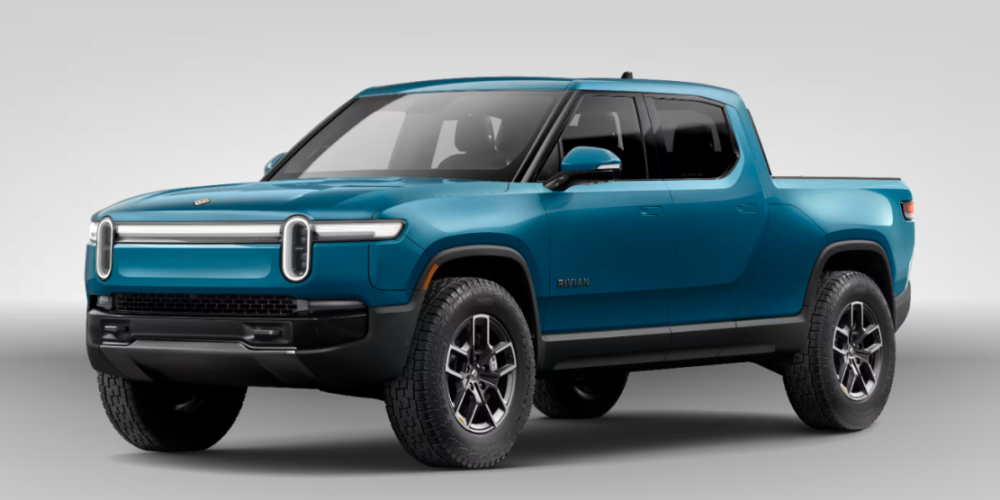
The U.S. 2027 Rivian R1T has a native NACS charging port and a choice of Large or Max batteries. For everyday use, the key question is how much energy you need to replace during your normal parking time. For longer journeys, plan around compatible fast chargers and the truck’s live charging estimate.
This guide covers Premium, Premium Long Range, Performance and Quad. Rivian introduced the new trim structure for 2027, so an older article organized only around Dual, Tri and Quad needs a configuration update. Rivian’s 2027 announcement.
2027 R1T Battery Capacity and Configuration
Swipe horizontally to compare columns. The first column stays visible.
| Configuration | Drive | Battery pack | Usable capacity |
|---|---|---|---|
| Premium | Dual-motor AWD | Large | 108 kWh |
| Premium Long Range | Dual-motor AWD | Max | 140 kWh |
| Performance | Tri-motor AWD | Max | 140 kWh |
| Quad | Quad-motor AWD | Max | 140 kWh |
Configuration mapping: 2027 announcement and Rivian comparison. Capacities: Rivian Gen 2 (2025+) usable-capacity table, which retains the Dual Large / Dual Max / Tri Max / Quad Max names. These are usable figures, not gross capacities.
Use the usable-capacity figure when calculating energy added between two displayed battery percentages. Gross capacity describes a different measurement and should not be substituted into that calculation.
The capacity mapping above combines Rivian’s current trim and pack information with its Gen 2 usable-capacity table. For example, Premium Long Range pairs the dual-motor drivetrain with the Max pack. Premium’s optional Power Upgrade is a separate option; it does not turn the truck into the tri-motor Performance trim.
How Far Can the 2027 R1T Travel?
Rivian quotes up to 420 miles for Premium Long Range, 371 miles for Performance and 374 miles for Quad on the specified 22-inch road-wheel configurations. With the new 20-inch Adventure wheels and all-season tires, the published figures are 300 miles for Premium, 380 for Premium Long Range and 348 for Performance. 2027 range and wheel details.
Match the wheel and tire specification when comparing ratings. The 20-inch all-season version and the 20-inch all-terrain version are separate EPA entries. Weather, speed, cargo, terrain and towing can change real-world range.
What Charging Port Does the 2027 Rivian R1T Use?
The 2027 model uses NACS for compatible AC and DC charging. An earlier R1T’s J1772/CCS1 connection instructions should not be carried over unchanged. Rivian identifies model years 2026 onward as native-NACS vehicles. Rivian charging guide.
Swipe horizontally to compare columns. The first column stays visible.
| Charging source | Connection | What to check |
|---|---|---|
| NACS AC home charger | Direct NACS connection | Vehicle compatibility and supported current |
| J1772 AC charger | Rivian-approved J1772 AC adapter | AC adapter approval and current rating |
| Compatible NACS DC station | Direct NACS connection | Vehicle and network access at that location |
| CCS1 DC station | Rivian-approved CCS1 DC adapter | Use the DC adapter, not the AC adapter |
Sources: Rivian charging information and R1T U.S. owner’s guide covering 2025–2027. A matching plug alone does not establish network access.
For routine charging at home, a compatible native-NACS charger offers a direct connection. If you already own J1772 equipment, check Rivian’s approved AC adapter arrangement before deciding whether to replace it. AC and DC adapters serve different purposes and are not interchangeable.
2027 Rivian R1T AC Charging Time Calculator
Select 2027 and the correct configuration, then set your starting and target battery percentages. Compare charger settings using the same charge window. A typical daily top-up may be much smaller than a 20%–80% recharge.
he estimate should use usable capacity, the lower of available charger power and vehicle acceptance, and the efficiency assumption displayed by the tool. Available voltage, temperature and charging settings can change the result.
Level 1 Charging at 120V
A compatible portable charging unit on a suitable household outlet can support small top-ups during long parking periods. Replacing a substantial portion of the R1T’s battery this way takes much longer than with Level 2. Compare the energy needed for your daily driving with what the outlet can deliver during your available hours.
Level 2 Charging at 240V
Swipe horizontally to compare columns. The first column stays visible.
| Charger setting | Nominal output | Use in the calculator |
|---|---|---|
| 32A | 7.68 kW | Compare the same starting and target charge |
| 40A | 9.60 kW | Compare the same starting and target charge |
| 48A | 11.52 kW | Vehicle acceptance may limit actual power |
Output = voltage × current ÷ 1,000, before charging losses. Rivian rates its NACS Wall Charger at 48A / 11.5 kW. This equipment rating is distinct from a vehicle-specific onboard-charger specification.
Rivian’s NACS Wall Charger provides a useful home-equipment reference: up to 48A and approximately 11.5 kW. Actual charging remains limited by the truck, supply and selected settings. A higher-rated charging station cannot force the vehicle to accept more power.
Use the calculator to compare a 32A, 40A and 48A setup. A lower setting may cover your daily mileage overnight; higher output becomes useful when you have a larger recharge or a shorter charging window.
Choosing a Home Charger for the R1T
When comparing a Level 2 home EV charger, start with NACS compatibility, adjustable current, cable reach and the electrical capacity available at your parking space. Check the distance to the charge port with the truck parked in its normal position.
Have the installation sized for the intended current and the equipment instructions. If your utility offers cheaper overnight hours, compare the available charging window with the time needed to reach your target. A short low-cost window can make additional charging output more useful.
Choose the daily charge target using the vehicle’s current guidance and your next journey. Avoid assuming that advice for an older Standard battery applies to every 2027 configuration.
DC Fast Charging and Tesla Superchargers
The native NACS port allows direct connection at compatible NACS DC locations, including supported Tesla Superchargers. Check location access in Rivian’s charging tools before relying on a particular stop. For CCS1 stations, use Rivian’s approved CCS1 DC adapter arrangement. Charging network and connector guidance.
Rivian’s Adventure Network support page gives an R1T/R1S reference of up to 150 miles added in 20 minutes. This is a conditional range-added claim, not a 10%–80% time for every 2027 battery and tire combination. The same page describes 300 kW station capability; that should not be read as the truck’s peak acceptance. Rivian fast-charging reference.
A useful trip plan allows for charging power to change throughout the session. Battery temperature, starting state of charge and station conditions affect the time required. Follow the vehicle’s preconditioning guidance and check its live estimate after connecting. R1T owner’s guide.
Charge enough for the next leg and an appropriate reserve. A station’s advertised maximum is not the average power delivered for the whole stop, and adding the final portion near full charge can take longer than an equivalent percentage at a lower charge level.
EPA Energy Use and Home Charging Costs
Swipe horizontally to compare columns. The first column stays visible.
| Configuration | Wheels / tires | kWh/100 mi | MPGe | Cost/100 mi |
|---|---|---|---|---|
| Premium | 20in AT | 44 | 76 | $7.48 |
| Premium | 20in | 43 | 79 | $7.31 |
| Premium | 22in | 39 | 85 | $6.63 |
| Premium Long Range | 20in AT | 43 | 78 | $7.31 |
| Premium Long Range | 20in | 42 | 80 | $7.14 |
| Premium Long Range | 22in | 39 | 87 | $6.63 |
| Performance | 20in AT | 50 | 68 | $8.50 |
| Performance | 20in | 47 | 72 | $7.99 |
| Performance | 22in | 45 | 76 | $7.65 |
| Quad | 20in AT | 50 | 67 | $8.50 |
| Quad | 22in UHP | 47 | 71 | $7.99 |
| Quad | 22in | 44 | 76 | $7.48 |
Source: EPA 2027 Rivian listings. AT = all-terrain; UHP = ultra-high-performance. Costs use the displayed rounded consumption and an illustrative $0.17/kWh tariff.
Multiply the EPA electricity-use figure by your charging-hour electricity price. The table’s $0.17/kWh rate is an example, not a national-average claim. It excludes charger purchase, installation and fixed utility fees.
EPA electricity consumption includes charging losses, so do not add another loss factor to these running-cost estimates. Do not use range multiplied by EPA consumption to infer battery capacity either: wall electricity and usable stored energy are different quantities.
Public Charging Costs
For a public session, multiply billed energy by the station tariff and add any applicable fees. For example, 60 kWh billed at an illustrative $0.45/kWh costs $27 before additional charges. That is a session example, not a guaranteed full-battery cost or a fixed driving distance.