
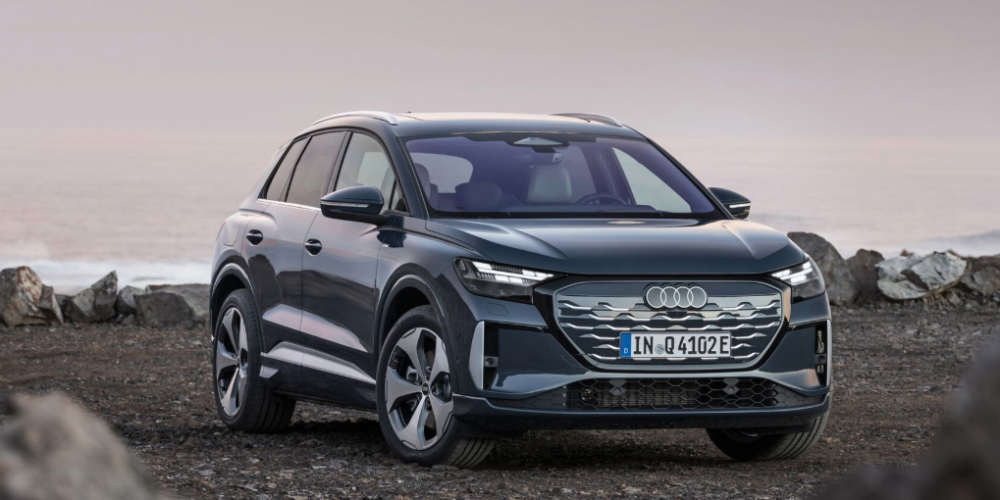
The U.S. 2026 Audi Q4 e-tron offers an 82 kWh battery and DC charging capability of up to 175 kW. At home, a compatible J1772 Level 2 charger lets you recharge while parked. On the road, plan around compatible CCS1 stations: Audi’s current NACS guidance excludes the Q4 from its adapter program.
This guide covers the Q4 45 e-tron SUV, Q4 55 e-tron quattro SUV and Q4 Sportback 55 e-tron quattro. Match the full model name when comparing range and costs, rather than treating every Q4 as the same configuration.
2026 Audi Q4 e-tron Battery Capacity and Range
Swipe horizontally to compare columns. The first column stays visible.
| U.S. configuration | Drive | Battery capacity (total) | EPA range |
|---|---|---|---|
| Q4 45 e-tron SUV | RWD | 82 kWh | 288 miles |
| Q4 55 e-tron quattro SUV | AWD | 82 kWh | 251 miles |
| Q4 Sportback 55 e-tron quattro | AWD | 82 kWh | 251 miles |
Battery sources: Audi USA’s 2026 SUV and Sportback pages. Range: EPA guide, Q4 55 and Sportback 55. Total capacity is not the usable-capacity input for a charging calculator.
The battery figure above describes total capacity. For charging-time estimates based on displayed battery percentage, the relevant input is usable capacity: the portion available within the battery’s operating window.
Audi’s non-U.S. model-year-2026 technical sheet lists 82 kWh gross and 77 kWh net for the Q4 45 and 55. That provides a reference for the distinction, but the U.S. product pages reviewed here state only 82 kWh. Confirm the U.S. vehicle’s usable-capacity specification before using 77 kWh as a calculator input. Audi MY26 technical sheet for another market.
Range is a standardized comparison, not a guarantee for every trip. Cold weather, highway speed, terrain, cargo and cabin heating can change how far you travel between charges. A larger rated range also does not automatically mean a higher charging-power limit.
AC Charging Time Calculator
Select model year 2026 and the configuration that matches your car. Set your starting and target charge levels, then compare Level 1 and Level 2 under the same conditions. For daily use, choose the top-up you normally need rather than always calculating a full recharge.
The result should reflect the vehicle’s usable capacity, accepted charging power and the tool’s charging-efficiency assumption. Temperature, available voltage and vehicle settings can change the actual time. Check the car’s own completion estimate during charging.
Level 1 Charging at 120V
A compatible charging unit on a suitable household outlet can help with small top-ups when the car stays parked for a long time. It is a slow way to replace a large share of the battery.
Whether Level 1 covers your needs depends on daily driving and available charging hours. Avoid relying on one fixed number of miles added per hour: that conversion changes with the car’s energy use.
Level 2 Charging at 240V
Swipe horizontally to compare columns. The first column stays visible.
| Configuration | EPA kWh/100 miles | Combined MPGe | Cost per 100 miles |
|---|---|---|---|
| Q4 45 e-tron SUV | 29 | 115 | $4.93 |
| Q4 55 e-tron quattro SUV | 35 | 97 | $5.95 |
| Q4 Sportback 55 e-tron quattro | 35 | 97 | $5.95 |
Source: EPA 2026 model listings. Costs use an illustrative $0.17/kWh household tariff and the displayed rounded EPA figures. EPA consumption includes charging losses; no extra loss factor is added.
Audi Hoffman Estates lists 11.5 kW AC capability for the 2026 Q4 45 and 55 SUVs. Audi’s non-U.S. MY26 sheet lists 11 kW. Use the rating for your market and exact configuration when setting up charging estimates; do not treat a charger’s 11.52 kW output as proof of the car’s acceptance rate. U.S. dealer specifications; Audi MY26 technical sheet.
A lower current setting may be enough for a routine overnight top-up. Higher output becomes useful when you need to replace more energy or have less time parked, up to the vehicle’s own limit.
Choosing a Home Charger for the Q4 e-tron
Start with a compatible J1772 connection, the distance from the charger to the car, and your normal parking time. Think about where the charge port will sit when the car is parked, so the cable can reach without being stretched.
When comparing a Level 2 home EV charger, consider adjustable current, cable length, scheduling and the installation suited to your parking space. Match the charger output to both your daily energy needs and the electrical capacity available at home.
A 32A or 40A setting may cover a modest commute during a long overnight window. A 48A setup offers more output for larger recharges where the vehicle can accept it. Have the installation assessed for the chosen current and follow the equipment instructions.
If your electricity plan offers cheaper hours, schedule charging within that window while allowing enough time to reach your target. Compare electricity prices over the full charging period, including any higher-rate hours needed to finish.
Charging Ports and Tesla Supercharger Compatibility
Swipe horizontally to compare columns. The first column stays visible.
| Current setting | Nominal output | How to compare |
|---|---|---|
| 32A | 7.68 kW | Check whether it covers your daily top-up |
| 40A | 9.60 kW | Compare against your overnight parking time |
| 48A | 11.52 kW | Accepted power remains limited by the vehicle |
Calculated as voltage × current ÷ 1,000. Supply-side power is not the same as energy stored in the battery after losses. The charger, installation and car must support the selected setting.
Do not assume the Q4 has the same Tesla access as the Q6, A6 e-tron or e-tron GT. At the time of this update, Audi’s U.S. NACS FAQ says the Q4 cannot use its NACS DC adapter or other NACS adapters and is subject to a future announcement. Audi’s current model-specific guidance.
Plan trips using stations confirmed compatible with the Q4. A connector adapter alone does not establish vehicle and network approval. Do not treat a station-provided adapter as evidence that the Q4 restriction has been lifted.
For home charging, a direct J1772 connection avoids relying on a NACS adapter. The Audi NACS DC adapter is intended for DC charging and is not an adapter for a Tesla home or Destination Charger.
DC Fast Charging: Up to 175 kW
Audi’s 2026 U.S. model pages advertise up to 175 kW DC, with a reference 10%–80% time of about 28 minutes. Use this as a reference under suitable conditions, not a guaranteed stop length. Audi Q4 SUV specifications; Sportback specifications.
Peak power is not maintained for the entire session. Battery temperature, starting charge level and station output affect the charging curve. A station marked 350 kW does not make a 175 kW-capable vehicle charge at 350 kW.
For trip planning, use the navigation system’s compatible station information and follow the vehicle’s charging preparation guidance. Check the estimated time during the session and allow a reserve for an alternative station if the first one is unavailable.
A short road-trip stop does not usually need to end at 100%. Charge enough for the next part of the journey, taking the route, weather and available charging locations into account.
EPA Energy Use and Home Charging Costs
Swipe horizontally to compare columns. The first column stays visible.
| Charging source | Vehicle connection | Compatibility |
|---|---|---|
| J1772 AC charger | J1772 | Direct connection to compatible equipment |
| CCS1 DC fast charger | CCS1 | Direct connection at compatible stations |
| NACS / Tesla Supercharger | NACS adapter would be required | Q4 currently excluded by Audi’s NACS guidance |
Sources: Audi charging FAQ and Audi NACS FAQ, checked November 17, 2026. Do not infer Q4 support from another Audi model’s compatibility.
The calculation is EPA kWh per 100 miles × your electricity price per kWh. Replace the example rate with the price that applies during your charging hours. The table covers electricity only, excluding charger purchase, installation and fixed utility fees.
EPA electricity-use figures include charging losses. Do not add a second loss allowance when using them for electricity-cost estimates. Also, multiplying range by these consumption figures does not establish usable battery capacity.
Public Charging Costs
Calculate a session from the energy billed by the station and its tariff. For example, 40 kWh billed at an illustrative $0.45/kWh costs $18 before additional fees. This is a session example, not the cost of filling the battery or driving a fixed distance.
Check membership prices, time-based tariffs, parking and idle charges before starting. Use the energy measured by the charger when comparing the receipt with the posted rate.