
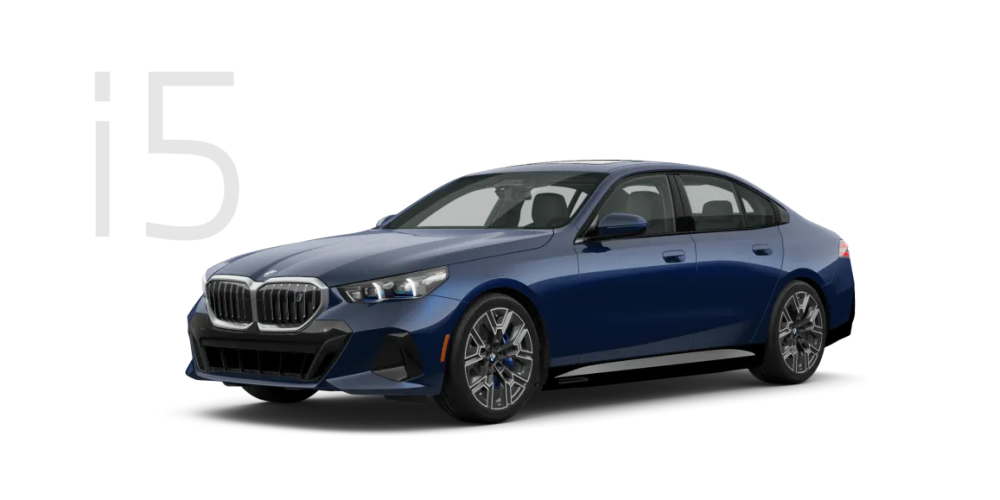
Before choosing a charger for a 2026 BMW i5, check the charging inlet on your car. BMW’s NACS transition means a guide that treats every i5 as a J1772/CCS1 vehicle can lead you to the wrong connector or adapter.
This guide covers the U.S. 2026 i5 eDrive40, xDrive40 and M60 xDrive sedan. It explains battery capacity, home charging options, public charging connections and electricity costs. AC charging time is handled by the calculator so you can compare the charge levels and charger settings that match your routine.
2026 BMW i5 Battery Capacity
Swipe horizontally to compare columns. The first column stays visible.
| Configuration | Total / gross capacity | Usable / net capacity |
|---|---|---|
| eDrive40 | 84.3 kWh | 81.2 kWh |
| xDrive40 | 84.3 kWh | 81.2 kWh |
| M60 xDrive | 84.3 kWh | 81.2 kWh |
Usable capacity is the energy available within the battery’s operating window. It is the appropriate starting point for a calculation based on displayed charge percentage. Gross capacity includes energy outside that window.
Using 81.2 kWh usable capacity, a 20%–80% top-up represents approximately 48.72 kWh added to the battery. Electricity drawn from the wall will be higher because some energy is used during charging. Apply the calculator’s efficiency assumption separately; do not substitute gross capacity for usable capacity to approximate losses.
Does the 2026 BMW i5 Have NACS or CCS1?
Check the actual vehicle rather than relying on the year alone. BMW USA explicitly identifies the 2026 i5 M60 as having a native NACS inlet. BMW also provides separate software and adapter instructions for CCS-equipped i5 vehicles, including the 2026 eDrive40 and xDrive40. BMW i5 FAQ; BMW software-update guidance.
Look inside the charge flap and check the VIN-specific vehicle documentation before buying equipment. A software update can enable access to a charging network, but it does not replace the physical inlet. If you are buying a car, ask the BMW Center to confirm its connector and included adapters before delivery.
Swipe horizontally to compare columns. The first column stays visible.
| Charging source | Car with J1772 / CCS1 inlet | Car with native NACS inlet |
|---|---|---|
| J1772 AC charger | Direct connection | Approved J1772-to-NACS AC adapter |
| NACS AC home charger | Approved NACS-to-J1772 AC adapter | Direct connection to compatible equipment |
| CCS1 DC fast charger | Direct connection | Approved CCS1-to-NACS DC adapter |
| Supported NACS Tesla Supercharger | Approved NACS-to-CCS1 DC adapter + required software | Direct NACS connection; station eligibility still applies |
Confirm the inlet on the car and use equipment approved for the vehicle and charging application. AC and DC adapters are not interchangeable. Sources: BMW i5 charging FAQ and BMW public charging guidance.
Adapter direction matters. An adapter that connects a NACS station to a CCS1 car cannot be used in reverse to connect a CCS1 station to a NACS car. Home AC charging and public DC charging also require different adapter types.
BMW i5 AC Charging Time Calculator
Select model year 2026 and your configuration, then choose the starting and target battery levels. Compare Level 1 and Level 2 using the same percentage range. For a normal overnight recharge, use the smaller top-up you expect to need after your daily driving.
he estimate depends on usable capacity, accepted charging power and the efficiency assumption shown in the tool. Cold conditions, vehicle settings and reduced supply voltage can change the result. The car’s own completion estimate will reflect conditions during the session.
Level 1: Small Top-Ups at 120V
A compatible charging unit on a suitable household outlet can be useful when daily driving is limited and the car stays parked for a long time. Replacing a substantial share of the battery takes much longer than on a 240V connection.
Assess whether the overnight energy added covers your daily use. A fixed claim about “miles added per hour” is less useful because electricity use varies with the configuration and driving conditions.
Level 2: Compare Charger Output and Vehicle Acceptance
Swipe horizontally to compare columns. The first column stays visible.
| Current setting | Nominal charger output | Practical meaning |
|---|---|---|
| 32A | 7.68 kW | Lower-power Level 2 option |
| 40A | 9.60 kW | More output for a shorter charging window |
| 48A | 11.52 kW | Vehicle AC limit may cap accepted power |
Power = volts × amps ÷ 1,000. These are supply-side figures, not the energy stored in the battery after losses. The installation, charger and vehicle must all support the selected current.
BMW’s current U.S. technical page lists up to 11.5 kW AC, while U.S. 2026 dealer equipment listings describe an 11 kW onboard charger. Confirm the rating for your specific vehicle when setting the calculator. A 48A charger can supply approximately 11.5 kW at 240V, but the vehicle controls how much it accepts. BMW technical data; 2026 dealer equipment listing.
Higher advertised charger output does not override the vehicle limit. A lower current setting can still cover your needs if you have enough time parked overnight.
Choosing a Home Charger for the BMW i5
Match the connector first, then choose output based on daily energy use and available charging time. A car with a J1772 inlet connects directly to a compatible J1772 charger; a car with native NACS connects directly to a compatible NACS charger. Other combinations require the appropriate approved AC adapter.
When comparing a Level 2 home EV charger, consider adjustable current, cable reach, charging schedules and the installation suited to your parking space. Confirm the product’s connector against your actual i5 before ordering.
A 32A or 40A setup may be sufficient for a modest daily top-up. A 48A setup provides more power when you need a larger recharge or have a shorter overnight window. Have the electrical installation assessed for the selected output and follow the equipment instructions.
If your utility offers cheaper charging hours, schedule around that period while allowing enough time to reach your target. Charging every day does not mean recharging from empty to full every day.
DC Fast Charging on Road Trips
BMW’s U.S. technical data lists up to 205 kW DC and a reference 10%–80% charging time of about 30 minutes for the i5 configurations shown. These are reference conditions, not a promise for every stop. BMW charging specifications.
Peak power is not maintained throughout a session. Battery temperature, state of charge and the station’s voltage, current and available power affect performance. Dividing battery capacity by 205 kW therefore does not give a reliable session time.
Use the vehicle’s navigation and battery-preparation guidance before a planned fast-charging stop. On arrival, check the vehicle’s estimated completion time. For a longer trip, aim for enough energy to reach the next suitable charging stop with a comfortable reserve.
Can the i5 Use Tesla Superchargers?
Yes, at eligible locations with the correct connection and vehicle setup. A native-NACS i5 can connect directly at supported NACS sites. A CCS-equipped car needs an approved DC adapter and the required software, or a compatible station-provided Magic Dock adapter. Check current access in the My BMW app. BMW public charging instructions.
Do not assume that every Tesla site is open to the vehicle, or that connector compatibility guarantees maximum charging power. Complete any required account and payment setup before your trip.
2026 BMW i5 Energy Use and Home Charging Cost
Swipe horizontally to compare columns. The first column stays visible.
| Configuration / wheels | EPA kWh/100 miles | Combined MPGe | Cost per 100 miles |
|---|---|---|---|
| eDrive40 · 19-inch | 31 | 110 | $5.27 |
| eDrive40 · 20-inch | 32 | 106 | $5.44 |
| eDrive40 · 21-inch | 34 | 98 | $5.78 |
| xDrive40 · 19-inch | 34 | 98 | $5.78 |
| xDrive40 · 20-inch | 35 | 96 | $5.95 |
| xDrive40 · 21-inch | 37 | 91 | $6.29 |
| M60 xDrive · 19-inch | 34 | 99 | $5.78 |
| M60 xDrive · 20-inch | 36 | 94 | $6.12 |
| M60 xDrive · 21-inch | 37 | 91 | $6.29 |
Source: EPA 2026 i5 listings. Costs use an illustrative $0.17/kWh household rate. EPA figures already include charging losses; no extra loss factor is applied. Actual costs depend on your tariff and driving.
The example cost is calculated as EPA kWh per 100 miles × $0.17/kWh. Replace the example price with the rate you actually pay during charging hours. These figures cover electricity only, excluding installation, charger purchase and fixed utility charges.
Match both the trim and wheel size. Temperature, speed, terrain and cabin heating can change real-world consumption, so standardized figures are a comparison tool rather than a prediction of every journey.
Public Charging Costs
Use electricity billed by the station multiplied by its tariff. For example, a session billed for 40 kWh at an illustrative $0.45/kWh costs $18 before additional fees. This represents one session, not a full battery charge or a fixed driving distance.
Check membership pricing, session fees and parking or idle charges. Do not add another loss allowance to electricity that has already been measured and billed by the charger.