
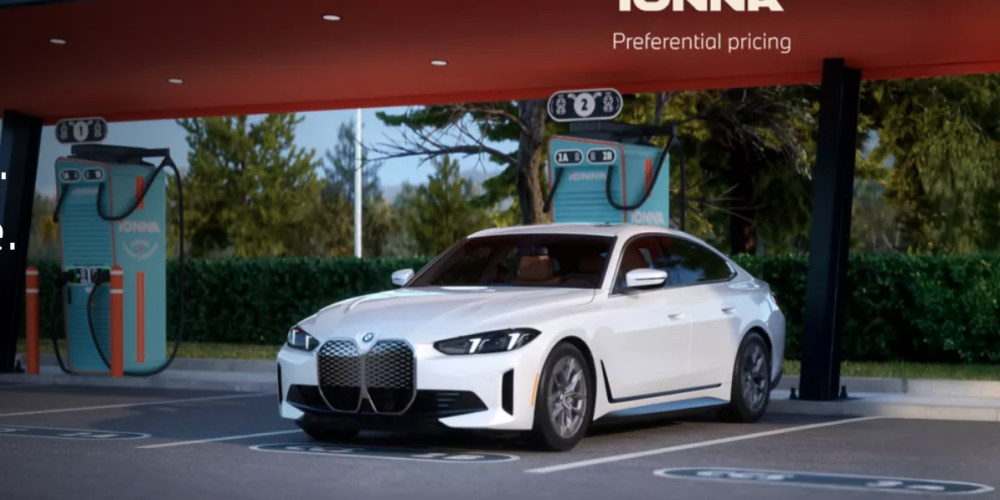
Charging a 2026 BMW i4 starts with matching the charger to your car and your routine. At home, a compatible J1772 Level 2 charger can replenish the battery while you are parked. On a trip, CCS1 stations and supported Tesla Superchargers provide DC charging options.
This guide covers the U.S. model year 2026 i4. It focuses on eDrive40, xDrive40 and M60 xDrive, with the EPA-listed eDrive35 included in the energy-use comparison. Specifications for another year or market should be checked separately.
What Changed for the 2026 BMW i4?
The performance version is now called i4 M60, replacing the M50 name. BMW also introduced efficiency improvements for the eDrive40 and M60. That makes a simple year change to an older charging guide insufficient: model names and energy-use figures need updating too. BMW’s U.S. 2026 update announcement.
Swipe horizontally to compare columns. The first column stays visible.
| Configuration | Total capacity | Usable capacity |
|---|---|---|
| eDrive40 | 83.9 kWh | 81.2 kWh |
| xDrive40 | 83.9 kWh | 81.2 kWh |
| M60 xDrive | 83.9 kWh | 81.2 kWh |
Total capacity and usable capacity describe different things. Total capacity includes energy outside the operating window available to the driver. For an estimate based on a change in displayed battery percentage, use the usable figure.
For example, a 20%–80% increase with an 81.2 kWh usable battery represents approximately 48.72 kWh stored in the battery. The electricity drawn from the wall will be higher because charging is not perfectly efficient. This calculation describes energy, not charging duration.
The EPA also lists a 2026 eDrive35. Its model-year-specific usable capacity has not been established for this guide, so the 81.2 kWh figure above should not be applied to that configuration.
EPA Energy Use: Match the Model and Wheels
Battery size alone does not tell you how much electricity a car needs for a journey. Wheel and tire configuration also matters, so use the entry that matches your vehicle when estimating running costs.
Swipe horizontally to compare columns. The first column stays visible.
| Configuration / wheels | EPA kWh/100 miles | Combined MPGe | Cost per 100 miles |
|---|---|---|---|
| eDrive35 · 19-inch | 31 | 109 | $5.27 |
| eDrive40 · 18-inch | 29 | 118 | $4.93 |
| eDrive40 · 19-inch | 31 | 108 | $5.27 |
| xDrive40 · 18-inch | 33 | 101 | $5.61 |
| xDrive40 · 19-inch | 36 | 94 | $6.12 |
| M60 xDrive · 19-inch | 34 | 98 | $5.78 |
| M60 xDrive · 20-inch | 41 | 81 | $6.97 |
Source: EPA’s 2026 i4 listings. Costs use an illustrative $0.17/kWh household rate, not a national average. EPA energy-use figures include charging losses; no second loss factor is added.
The cost column is calculated as kWh per 100 miles × your electricity price per kWh. Replace the example tariff with the rate charged during your actual home charging hours. Fixed utility charges, installation and equipment costs are excluded.
These standardized ratings help compare configurations. Your consumption can change with weather, speed, terrain and cabin heating or cooling. Do not multiply rated range by EPA consumption to infer usable battery capacity: the consumption measurement includes charging energy losses.
BMW i4 AC Charging Time Calculator
Select 2026 and your configuration, then choose your starting and target battery levels. Compare Level 1 and Level 2 charging using the same percentage range. For everyday driving, select the amount you usually need to replace overnight rather than always calculating an empty-to-full session.
Results are estimates. Available voltage, vehicle settings, temperature and charging losses affect the time required. The calculator should show its efficiency assumption and apply the vehicle’s AC input limit when comparing charger settings.
Level 1 Charging at 120V
A compatible portable charging unit on a suitable household outlet can cover small top-ups when the car stays parked for long periods. It is a slow option for replacing a large share of the battery. Compare your expected daily use with the calculator result before depending on Level 1 as your only charging source.
Level 2 Charging at 240V
Level 2 provides more power and can make a larger overnight recharge practical. The table below separates a charger’s output from what an 11 kW onboard charger can accept.
Swipe horizontally to compare columns. The first column stays visible.
| Current setting | Charger output | With an 11 kW AC vehicle limit |
|---|---|---|
| 32A | 7.68 kW | Up to 7.68 kW |
| 40A | 9.60 kW | Up to 9.60 kW |
| 48A | 11.52 kW | Up to 11 kW |
A 48A charger supplies a nominal 11.52 kW at 240V, but a vehicle limited to 11 kW will not use all of that output. Moving to an even higher-rated charger will not bypass the onboard charging limit.
Choosing a Home Charger for Your BMW i4
Start with your parking time and daily driving. A 32A or 40A setting may cover your normal top-up during a long overnight window. A 48A setup offers more headroom for larger recharges, subject to the vehicle limit and the electrical supply available at home.
When choosing a Level 2 home EV charger, compare connector compatibility, adjustable current, cable reach and installation requirements. A J1772 model connects directly to the U.S. i4 covered here. Position the charger so the cable reaches the car comfortably in its normal parking space.
Have the installation assessed for the selected charging current and follow the equipment instructions. If your utility offers time-based rates, schedule charging within the cheaper period while allowing enough time to reach your target.
Charging Ports and Tesla Supercharger Access
Swipe horizontally to compare columns. The first column stays visible.
| Charging source | Connection to the car | What to check |
|---|---|---|
| J1772 AC charger | Direct J1772 connection | Charger current and available supply |
| CCS1 DC fast charger | Direct CCS1 connection | Station output and availability |
| NACS Partner Tesla Supercharger | BMW-approved NACS DC adapter | Vehicle software and station eligibility |
| Tesla Supercharger with Magic Dock | Station-provided CCS adapter | Use a location open to your vehicle |
Follow BMW’s public charging instructions. A DC Supercharger adapter is not an AC adapter for a Tesla home charger.
The U.S. i4 covered here uses J1772 for AC and CCS1 for DC. Access to NACS charging stations through an adapter does not change the car’s physical inlet.
BMW now supports charging at eligible NACS Partner Tesla Superchargers using its approved adapter and the required vehicle software. BMW’s instructions identify the Lectron Vortex Plus DC adapter; confirm the currently approved equipment and your car’s readiness before travelling. Magic Dock locations provide their own CCS adapter. BMW’s current Supercharger guidance.
Check the exact station in your charging app. Access does not extend to every Tesla site, and having a compatible connector does not guarantee the station will deliver the car’s maximum charging rate.
DC Fast Charging: Peak Power Is Not Average Power
BMW M publishes a maximum DC charging input of 205 kW for the i4 M60 xDrive. Treat this as a peak specification for that model, not a guaranteed rate throughout a session or a figure to copy to an eDrive35. BMW M charging specifications.
Battery temperature, starting charge level and station capabilities all influence actual performance. Power typically changes as the session progresses, so dividing battery capacity by peak power does not give a reliable 10%–80% charging time.
Use the vehicle’s route planning and follow its instructions for preparing the battery before a charging stop. During the session, use the car’s current completion estimate to decide how long to stay. On a road trip, the charge needed to reach the next suitable stop may be more useful than a full battery.
What Does Public Charging Cost?
Calculate a public session from the energy billed and the station tariff. For example, 40 kWh billed at an illustrative $0.45/kWh costs $18 before any additional fees. That is a session example, not the cost of a full charge.
Check for membership pricing, time-based charges, parking and idle fees. When using electricity already measured by the charger, do not add another charging-loss allowance. Home cost per distance and a public session receipt are different comparisons.