
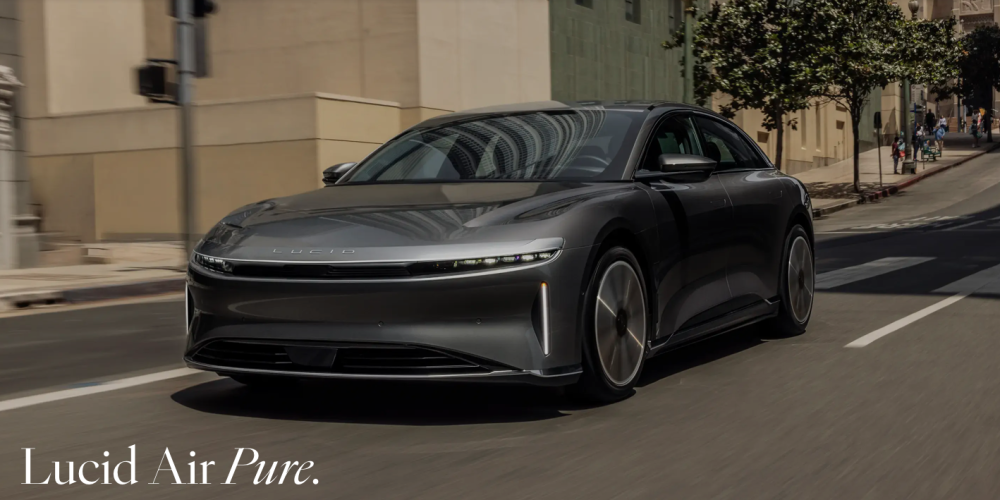
The U.S. 2027 Lucid Air uses a J1772/CCS1 combination charging port: J1772 for AC charging at home and CCS1 for DC fast charging. Pure, Touring, Grand Touring and Sapphire support up to 19.2 kW of AC charging, while peak DC power varies by trim.
For everyday use, the important question is whether your home setup can replace the energy you use between trips. This guide explains how to compare charging times, choose a suitable charger and estimate electricity costs. It covers U.S. 2027 models; specifications and connectors can differ in other markets.
2027 Lucid Air Battery and Charging Specifications
Lucid offers different battery packs across the Air range. The table below uses the pack descriptions and charging limits listed in Lucid’s 2027 configuration comparison.
Swipe horizontally to compare columns. The first column stays visible.
| U.S. configuration | Battery pack structure | Max AC | Peak DC |
|---|---|---|---|
| Pure RWD | 16 modules; Long Range Battery | 19.2 kW | 250 kW |
| Touring AWD | 18 modules; Long Range Battery | 19.2 kW | 250 kW |
| Grand Touring AWD | 22 modules; Extended Range Battery | 19.2 kW | 300 kW |
| Sapphire AWD | 22 modules; Extended Range Battery | 19.2 kW | 300 kW |
Sources: Lucid’s 2027 trim comparison and Sapphire comparison. The battery descriptions above identify pack structure, not usable energy in kWh. Peak charging power is not a session average.
For charging-time estimates based on battery percentage, the relevant input is usable battery capacity. A module count is not a kWh rating. Also, multiplying EPA range by EPA energy consumption does not establish usable battery capacity because the consumption measurement includes energy used during charging.
EPA Energy Consumption by Trim and Wheel Size
Wheel choice matters when comparing running costs. The 19-inch and 20-inch versions of the same trim have separate EPA ratings, so use the entry that matches your car.
Swipe horizontally to compare columns. The first column stays visible.
| Configuration | Wheels / EPA entry | Combined energy use | Combined MPGe |
|---|---|---|---|
| Pure RWD | 19″ | 23 kWh/100 miles | 146 |
| Pure RWD | 20″ | 26 kWh/100 miles | 129 |
| Touring AWD | 19″ | 25 kWh/100 miles | 134 |
| Touring AWD | 20″ | 27 kWh/100 miles | 123 |
| Grand Touring AWD | 19″ | 26 kWh/100 miles | 128 |
| Grand Touring AWD | 20″ | 28 kWh/100 miles | 120 |
| Grand Touring AWD | 21″ | 30 kWh/100 miles | 112 |
| Sapphire AWD | EPA-listed Sapphire configuration | 32 kWh/100 miles | 105 |
Values are the rounded figures displayed by EPA for model year 2027. EPA names Grand Touring “Air G Touring XR AWD.” Source: 2027 EPA vehicle listings. These standardized ratings are not a guarantee of real-world consumption.
For example, the Pure with 19-inch wheels is rated at 23 kWh per 100 miles, versus 26 kWh for the 20-inch version. Larger wheels do not automatically change the car’s maximum AC charging power, but the higher energy-use rating affects electricity cost per mile.
What Charging Port Does the 2027 Lucid Air Use?
The Air’s combination port accepts a J1772 AC connector or a CCS1 DC connector. A compatible J1772 home charger can connect directly. NACS equipment requires the appropriate adapter, depending on whether the station supplies AC or DC power.
Swipe horizontally to compare columns. The first column stays visible.
| Charging equipment | Connection required | Adapter needed? |
|---|---|---|
| J1772 Level 1 / Level 2 | J1772 AC | No |
| CCS1 DC fast charger | CCS1 DC | No |
| NACS AC charger | NACS-to-J1772 AC adapter | Yes: use a Lucid-approved adapter |
| Compatible NACS DC station | NACS-to-CCS1 DC adapter | Yes, unless the station provides a compatible Magic Dock |
AC and DC adapters serve different purposes and are not interchangeable. Check station access before travelling. Sources: Lucid Air charging guide and public charging guidance.
Do not confuse Air with Gravity when shopping for a charger or adapter. Lucid’s home charging guide distinguishes Air’s J1772/CCS1 port from Gravity’s native NACS port. Check the direction and intended use of an adapter before purchasing it.
2027 Lucid Air Home Charging Time Calculator
Select your model year and configuration, then choose the starting and target battery percentages. Compare Level 1 and Level 2 options, keeping the same charge range when comparing charger outputs.
A 20%–80% comparison is useful for a substantial recharge. For normal commuting, try the smaller battery-percentage increase you actually need overnight. A full 0%–100% estimate can make daily charging look more demanding than it is.
Calculator results are estimates, not manufacturer-tested charging times. Temperature, charging losses, power availability and vehicle settings can affect the result. Review the assumptions displayed by the tool when comparing its estimate with a real charging session.
Level 1 or Level 2?
Level 1 charging uses compatible equipment and a suitable 120V outlet. It may cover light driving when the car stays parked for a long time, but it is a slow way to replace a substantial amount of energy.
A suitable 240V Level 2 setup provides more power and more flexibility for overnight charging. Choose its output around your daily energy needs and parking time, rather than assuming you must install the highest power the vehicle can accept.
Does a 48A Charger Deliver the Air’s Full AC Charging Power?
No. At a nominal 240V, a 48A charger supplies up to 11.52 kW, below the Air’s 19.2 kW AC limit. At the same voltage, 32A corresponds to 7.68 kW and 40A to 9.6 kW. These figures describe electrical input power; charging losses reduce the energy stored in the battery.
Reaching 19.2 kW at 240V requires 80A charging equipment and a suitable installation. That is a separate installation choice, not a setting that a 48A unit can provide. Ask an electrician to assess the supply and follow the equipment’s installation requirements.
Choosing a Home Charger for Your Lucid Air
Start with your normal mileage, your available charging window and the electrical supply at your parking space. A lower-output setup may be sufficient for a modest commute, while a higher-output installation can help when you drive farther or spend less time at home.
When choosing a Level 2 home EV charger, compare connector compatibility, adjustable current, cable reach and installation requirements. A J1772 model provides a direct connection to the Air; a NACS model requires a Lucid-approved AC adapter.
A 48A setup can be a practical option without reaching the car’s maximum AC capability. Use your expected charging time to decide whether the additional installation cost of higher-current equipment would provide a meaningful benefit for your routine.
If your utility offers time-of-use pricing, schedule charging during the lower-cost period when practical. Make sure the selected current and charging window still provide enough energy for your next trip.
DC Fast Charging on Road Trips
The 2027 Pure and Touring have a published peak DC charging power of 250 kW; Grand Touring and Sapphire reach up to 300 kW. Those peaks apply under suitable conditions and do not stay constant throughout a session.
Lucid’s 2027 model pages advertise adding 200 miles in approximately 16 minutes for Pure and Touring, 12 minutes for Grand Touring, and 15 minutes for Sapphire. These are manufacturer estimates under specified fast-charging conditions, not 10%–80% times or full-charge times. See the official comparison and its charging footnotes.
A 350 kW station rating describes the equipment’s capability, not a promise that your Air will draw 350 kW. The battery’s state of charge, temperature, station voltage and available output all affect the actual rate.
For a planned fast-charge stop, use the vehicle’s navigation and battery-preconditioning features according to Lucid’s guidance. Preparing the battery can improve charging performance, especially when conditions are cold. Lucid’s public charging guide explains Smart Preconditioning.
Can the Lucid Air Use Tesla Superchargers?
Yes, at compatible locations with a Lucid-approved NACS-to-CCS1 DC adapter or a suitable station-provided Magic Dock. Check compatibility in the Lucid app before travelling; a station being branded Tesla does not by itself confirm access.
Access does not guarantee the Air’s maximum charging speed. Lucid explains that at many approximately 400V Superchargers, the Air uses its Wunderbox boost system and is limited to about 50 kW. Do not apply this figure to every station, but account for the limitation when comparing stops. A compatible high-voltage CCS1 charger may offer a quicker recharge. Source: Lucid’s Supercharger guidance.
How Much Does It Cost to Charge a 2027 Lucid Air?
To estimate home electricity cost per 100 miles, multiply the EPA energy-use rating for your configuration by your electricity rate. At an example price of $0.17/kWh, the rated configurations below cost approximately $3.91–$5.44 per 100 miles.
Swipe horizontally to compare columns. The first column stays visible.
| Configuration | EPA kWh/100 miles | Cost per 100 miles |
|---|---|---|
| Pure RWD 19″ | 23 | $3.91 |
| Pure RWD 20″ | 26 | $4.42 |
| Touring AWD 19″ | 25 | $4.25 |
| Touring AWD 20″ | 27 | $4.59 |
| Grand Touring AWD 19″ | 26 | $4.42 |
| Grand Touring AWD 20″ | 28 | $4.76 |
| Grand Touring AWD 21″ | 30 | $5.10 |
| Sapphire AWD EPA-listed Sapphire configuration | 32 | $5.44 |
Example electricity price: $0.17/kWh, not a claimed national average. Calculations use rounded EPA consumption ratings, which include charging losses; no additional loss factor is applied. Installation, equipment and fixed utility charges are excluded.
Formula: kWh per 100 miles × electricity price per kWh = electricity cost per 100 miles.
Use the rate that applies when you normally charge. Actual driving conditions can move your energy use above or below the EPA rating, and your bill may also include fixed charges unrelated to the charging session.
Public Charging Costs
Check the station’s live tariff, including any membership, session, parking or idle charges. A public DC receipt depends on the energy billed and the operator’s pricing; it should not be predicted from the home-cost table alone. For trip planning, compare both the expected stop duration and the total session cost.