
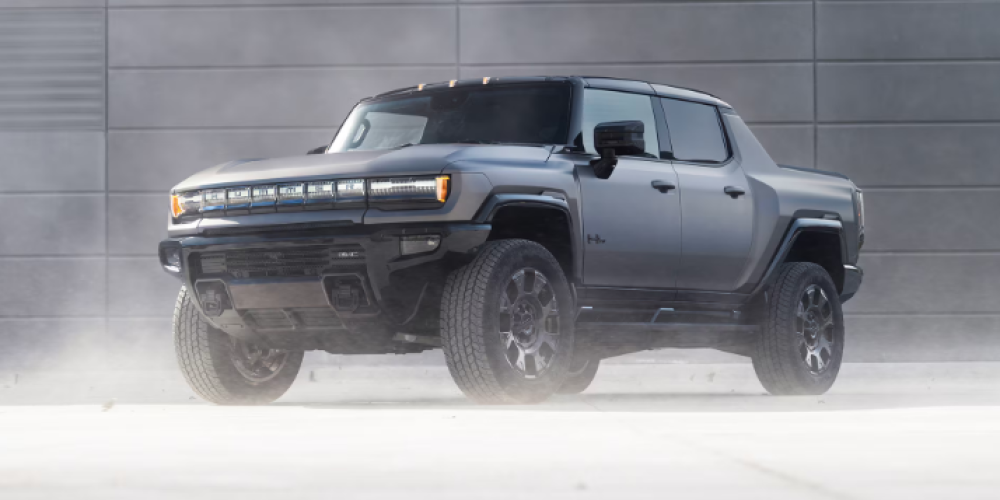
The U.S. 2026 GMC HUMMER EV Pickup uses J1772 for AC charging and CCS1 for DC fast charging. GM lists home charging capability of up to 19.2 kW and available DC fast charging of up to 350 kW, depending on equipment. A 48A home charger supplies up to 11.52 kW at 240V, so it does not reach the truck’s full AC capability.
This guide focuses on the 2026 Pickup, including 2X and 3X battery configurations. It explains how to compare home charging options, use compatible public stations and estimate session costs without confusing battery capacity, charging power and driving range.
2026 HUMMER EV Pickup Battery Options and Range
Identify the battery pack before comparing charging times. The 3X badge alone does not tell you whether the truck has the standard pack or the optional larger pack.
Swipe horizontally to compare columns. The first column stays visible.
| Configuration | Battery pack | GM-estimated range, up to |
|---|---|---|
| 2X, standard configuration | 20 modules | 316 miles |
| 3X, standard battery | 20 modules | 312 miles |
| 3X, optional larger battery | 24 modules | 363 miles |
Range figures follow the 2026 trim descriptions on the GMC product page. These are GM estimates, not EPA energy-consumption ratings. Wheels, tires, packages and driving conditions affect range. Module count is not a usable-capacity figure in kWh.
Check your truck’s build information for its exact equipment. A larger battery can store more energy, but it also takes more energy to move through the same percentage range. A daily top-up and a nearly empty-to-full recharge are very different tasks.
Use usable battery capacity for percentage-based charging estimates. Neither the pack’s module count nor its advertised driving range is a substitute for that input. Do not use an SUV specification for the Pickup, or assume all model years have identical packs.
2026 HUMMER EV Pickup Home Charging Time Calculator
Select the 2026 Pickup configuration that matches your battery pack. Set your starting and target charge levels, then compare Level 1 and Level 2 charging for the same battery-percentage range.
A 20%–80% estimate can help plan a substantial recharge. For normal commuting, adjust the range to represent the smaller top-up you expect to need overnight. Calculator results are estimates based on the assumptions displayed by the tool; weather, power availability and vehicle charging settings can change the actual time.
Level 1 Charging: Suitable for Small Top-Ups
A compatible charging unit and suitable 120V outlet can provide Level 1 charging. The available power is low compared with a 240V setup, making it a slow way to replace a substantial amount of energy in a large electric pickup.
Whether it covers your needs depends on how far you drive and how long you can stay plugged in. Use the calculator for your actual top-up rather than relying on a vague “more than 24 hours” full-charge claim.
Level 2 Charging: Compare Power Before Comparing Time
GM’s 2026 Pickup fleet sheet lists AC charging rates up to 19.2 kW. Your home charger, electrical supply and vehicle settings determine how much of that capability is available in practice.
Swipe horizontally to compare columns. The first column stays visible.
| Charging current | Nominal input power | Relative to 19.2 kW vehicle limit |
|---|---|---|
| 32A | 7.68 kW | Below the limit |
| 40A | 9.60 kW | Below the limit |
| 48A | 11.52 kW | Below the limit |
| 80A | 19.20 kW | Matches the published maximum |
Calculated as volts × amps ÷ 1,000. These are supply-side power figures, not battery energy added per hour after losses. Each setting requires compatible equipment and a suitable installation. Vehicle maximum: GM’s 2026 Pickup fleet sheet.
A 48A charger cannot deliver 19.2 kW at 240V. It can still be a useful overnight charging option, but an 80A output is needed to supply 19.2 kW at that voltage. Installing higher-current equipment is a separate electrical decision, not a software setting that turns a 48A unit into an 80A charger.
Charging power also should not be presented as a fixed number of driving miles added per hour. That conversion depends on energy consumption, which changes with speed, temperature, tires, payload and towing.
Which Home Charger Should You Choose?
Start with the amount of energy you typically need to replace, then consider how many hours the truck stays parked. If your daily use is modest and you have a long overnight window, a lower-current setup may be sufficient. A shorter window or heavier use can make higher output more valuable.
When comparing a Level 2 home EV charger, look for the right connector, adjustable current, adequate cable reach and an installation method suited to your parking space. A compatible J1772 version connects directly to the 2026 Pickup.
Have an electrician assess your available supply and follow the charger’s installation instructions. If your utility offers lower overnight rates, scheduling charging can reduce electricity costs, provided the available window is long enough.
Choose a charger around your routine rather than treating maximum vehicle capability as a minimum requirement. A 48A unit should be described as an 11.52 kW option at 240V, not the fastest possible home charging setup for this truck.
Charging Ports and Adapter Compatibility
The 2026 Pickup’s combination inlet supports J1772 AC and CCS1 DC charging. NACS charging equipment requires the appropriate adapter and station compatibility.
Swipe horizontally to compare columns. The first column stays visible.
| Charging station | Connection | Adapter requirement |
|---|---|---|
| J1772 AC charger | J1772 | Direct connection |
| CCS1 DC fast charger | CCS1 | Direct connection |
| Compatible NACS AC charger | NACS to J1772 | GM-approved AC adapter |
| Supported Tesla Supercharger / NACS DC station | NACS to CCS1 | GM-approved DC adapter, or compatible station-provided adapter |
Confirm station access and adapter approval for the vehicle. AC and DC adapters are not interchangeable. Sources: 2026 owner’s manual and GM NACS Level 2 adapter.
The GM NACS Level 2 adapter is intended for compatible NACS AC equipment, such as supported home wall connectors. It serves a different purpose from the adapter used at a DC Supercharger. Confirm that the adapter is approved for your vehicle and charging application.
DC Fast Charging on Road Trips
GM’s 2026 fleet sheet lists DC charging up to 300 kW among standard features and up to 350 kW among available features. The main Pickup page also advertises available 800V DC fast charging up to 350 kW. Check your truck’s equipment rather than assuming every configuration supports the higher figure. Sources: 2026 GM fleet sheet and GMC Pickup specifications.
Those numbers are peak capabilities, not the power you will receive continuously. Actual output depends on the truck’s battery temperature and state of charge, the station’s voltage and current capabilities, and any power sharing or equipment limits.
A charger labelled “350 kW” does not guarantee a 350 kW session. Similarly, dividing battery capacity by peak power is not a reliable way to calculate a 10%–80% fast-charge time. For trip planning, use the vehicle’s current charging estimate and allow for station availability.
Plan stops with enough reserve to reach an alternative station if necessary. Follow the owner’s manual for battery preparation and charging settings, and consider the extra energy demand of towing or carrying a heavy load.
Can the 2026 HUMMER EV Pickup Use Tesla Superchargers?
Yes, at supported locations using the appropriate GM-approved NACS DC adapter. GMC’s 2026 product page lists Tesla Supercharger access through the myGMC app. Use the app to confirm compatible locations and complete any required setup before travelling. GMC charging and app information.
Do not assume every Tesla station is available to the truck or that every supported stall can provide its maximum DC rate. Connector compatibility and charging performance are separate questions. Check cable reach and parking layout as well, particularly when towing.
How Much Does It Cost to Charge a HUMMER EV Pickup?
The most direct session-cost estimate is electricity billed × price per kWh. This avoids treating one energy-consumption figure as representative of every battery, wheel and driving configuration.
Swipe horizontally to compare columns. The first column stays visible.
| Energy billed by charger | Home example: $0.17/kWh | Public example: $0.45/kWh |
|---|---|---|
| 20 kWh | $3.40 | $9.00 |
| 50 kWh | $8.50 | $22.50 |
| 100 kWh | $17.00 | $45.00 |
Both prices are illustrative scenarios, not current national averages. The energy amounts represent billed electricity, not a full battery charge or a specific driving distance. Taxes, parking, idle and session fees are excluded. No additional loss factor is applied to electricity already measured at the charger.
For example, a session billed for 50 kWh costs $8.50 at $0.17/kWh, or $22.50 at $0.45/kWh, before additional fees. These examples do not mean that 50 kWh fills the battery or provides a fixed driving distance.
Use the rate that applies during your home charging hours. For public charging, check the live tariff and any membership, session, parking or idle charges. If a station charges by time rather than energy, calculate the cost using that tariff.
Estimating Your Own Cost per Mile
For a useful household estimate, track charger-recorded electricity over several comparable charging cycles and divide the electricity cost by the miles driven over the same period. Start and end at similar battery charge levels so the comparison is meaningful.
Vehicle-display consumption and electricity measured at the charger are different quantities because charging uses energy too. Do not add a second loss factor to electricity already measured and billed at the charger.
What Changes for the 2027 Model?
GMC has announced native NACS charging inlets across the 2027 HUMMER EV Pickup and SUV range. That change does not apply retroactively to the 2026 Pickup described here. Check model year before choosing an adapter or applying a charging guide. GMC’s 2027 announcement.