
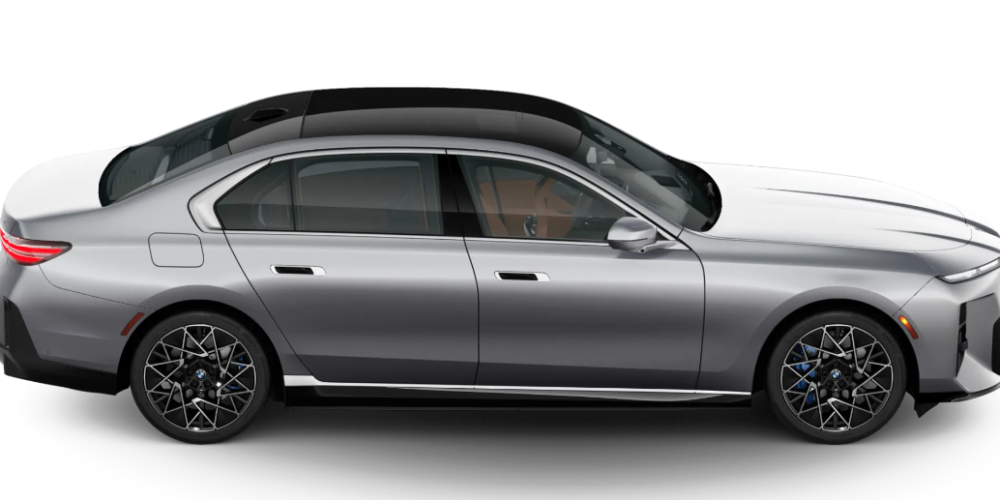
The U.S. 2027 BMW i7 uses a NACS charging port for home charging and compatible public charging stations. For everyday driving, the practical question is how much energy you need to replace overnight. On longer trips, DC fast charging can help you get back on the road sooner.
This guide covers the i7 xDrive50 and xDrive60, with an AC charging calculator, connector guidance and home electricity-cost examples. Specifications here apply to the U.S. 2027 model; check your vehicle’s documentation if you own an earlier i7 or a version sold in another market.
2027 BMW i7 Battery and EPA Range
BMW’s U.S. technical information lists usable battery capacity of up to 112.5 kWh for the updated i7. Usable capacity describes energy available to the vehicle; it should not be confused with total battery capacity. BMW’s U.S. announcement provides the battery and charging specifications.
Range and efficiency depend on the version and its wheels and tires. The table below compares two specific EPA-rated configurations.2027 BMW i7 EPA Range and Energy Use
Swipe horizontally to compare columns. The first column stays visible.
| Specification | i7 xDrive50 | i7 xDrive60 |
|---|---|---|
| Wheel and tire configuration | 20-inch summer tires | 20-inch summer tires |
| EPA range | 373 miles | 362 miles |
| EPA combined electricity use | 36 kWh/100 miles | 37 kWh/100 miles |
| EPA combined efficiency | 95 MPGe | 92 MPGe |
These ratings apply to the configurations shown, not every wheel and tire option. EPA range is a standardized comparison, not a guaranteed driving distance. Source: 2027 BMW i7 EPA ratings.
Use the rating for your own configuration when comparing running costs. Highway speed, cold weather, cabin heating and other driving conditions can change the distance you travel between charging stops.
What Charging Port Does the 2027 BMW i7 Use?
The U.S. 2027 i7 has a NACS charging port. That makes connector choice an important consideration when buying a home charger or reusing equipment from a previous EV. BMW USA also confirms that an adapter for CCS Level 3 charging is included.
Swipe horizontally to compare columns. The first column stays visible.
| Charging equipment | Connection to the i7 | What to check |
|---|---|---|
| NACS AC home charger | NACS connection | Vehicle compatibility and available AC output |
| J1772 AC charger | Compatible J1772-to-NACS AC adapter | BMW guidance, adapter compatibility and current rating |
| CCS1 DC fast charger | Compatible CCS1-to-NACS DC adapter | Use the adapter specified for the vehicle |
| Tesla Supercharger | NACS connection at supported locations | Confirm station access in the BMW charging network |
BMW confirms a NACS port and an included CCS Level 3 adapter for the U.S. model. Do not assume a J1772 AC adapter is also included. AC and DC adapters are not interchangeable. Source: BMW USA i7 charging information.
If you already have a J1772 home charger, check the approved AC adapter options before replacing the entire charger. Confirm compatibility for the vehicle, charger and adapter together, including the intended charging current.
2027 BMW i7 Home Charging Time Calculator
Select the model year and configuration, set your starting and target battery percentages, and compare Level 1 with Level 2 charging. The charger-output comparison helps you see whether a lower-current option fits your overnight parking time.
For a useful comparison, start with the same battery range for each charger setting. A 20%–80% estimate represents a substantial top-up, while your normal daily recharge may involve a much smaller percentage change.
The results are estimates based on the vehicle data and assumptions shown in the calculator. Charging losses, battery temperature, available power and vehicle charging settings can affect the time you actually need. The charger’s advertised output also does not override the vehicle’s AC input limit.
Level 1 vs. Level 2: Which Fits Your Routine?
Level 1 uses a compatible charging unit connected to a suitable 120V outlet. It can be useful for light driving or occasional top-ups, but a large battery recharge takes much longer. Check the calculator against the amount of energy you need to replace rather than assuming a standard outlet will cover every commute.
Level 2 uses a suitable 240V supply and provides more charging power. It is the more practical option when you need substantial overnight replenishment. Compare the available current settings in the calculator before deciding how much charging capacity to install.
Choosing a Home Charger for Your BMW i7
Start with three things: your daily driving distance, how long the car normally stays parked, and the electrical capacity available at your parking space. A faster charger is useful when your charging window is short, but it is not automatically necessary for a modest daily commute.
A 32A or 40A setup may be sufficient when you have enough overnight charging time. A higher-current setup can shorten larger recharges, up to the vehicle’s AC limit. Use the calculator to compare these options under the same starting and target battery percentages.
When comparing a Level 2 home EV charger, look for a compatible connector or approved adapter arrangement, adjustable output, a cable that comfortably reaches your parking position, and an installation method suited to your home.
Have a qualified electrician assess the available supply and installation requirements. Match the charger setting to the installed circuit and equipment instructions. Scheduling charging during a lower-priced electricity period may also reduce running costs if your utility offers a time-of-use tariff.
DC Fast Charging and Tesla Supercharger Access
DC fast charging is most useful on journeys when you need to add energy during a shorter stop. BMW publishes the following reference figures for the updated i7 in its U.S. launch information.
Swipe horizontally to compare columns. The first column stays visible.
| Charging specification | BMW-published figure |
|---|---|
| Peak DC charging power | Up to 250 kW |
| Reference charging window | 10% to 80% |
| Reference charging time | As little as 28 minutes |
BMW’s U.S. launch information describes performance at certain fast-charging stations. Actual results depend on battery temperature, state of charge and station output. Peak power is not maintained throughout the session. Source: BMW U.S. technical information.
Do not calculate a full charging session by dividing battery capacity by the peak power figure. Charging power changes through the session, and a station’s advertised rating does not guarantee the car will receive that output continuously.
BMW’s charging route planning and battery preparation can help prepare the car for a DC stop. Follow the vehicle’s guidance when navigating to a compatible fast charger. Arriving with a battery that is too cold or already at a high state of charge can change the charging experience. BMW describes these charging features here.
Can the 2027 BMW i7 Use Tesla Superchargers?
Yes—BMW USA confirms access to Tesla Superchargers within the BMW ChargingNetwork for the NACS-equipped 2027 i7. Check the specific location in the charging network before setting off; having a NACS port does not mean every Tesla charging location is available to every vehicle. See BMW’s current i7 charging information.
How Much Does It Cost to Charge a 2027 BMW i7 at Home?
A useful starting point is cost per 100 miles. Multiply the EPA electricity-use rating for your configuration by your household electricity price. For example, at $0.17 per kWh, the two configurations below cost approximately $6.12 and $6.29 per 100 miles.
Swipe horizontally to compare columns. The first column stays visible.
| Configuration | EPA electricity use | Cost at $0.17/kWh |
|---|---|---|
| i7 xDrive50 20-inch summer tires | 36 kWh/100 miles | $6.12 |
| i7 xDrive60 20-inch summer tires | 37 kWh/100 miles | $6.29 |
$0.17/kWh is an illustrative household electricity rate, not a claimed national average. EPA electricity-use figures include charging losses; no additional loss factor is applied here. Actual costs depend on driving conditions and your tariff. Source: EPA electricity-use ratings.
Calculation: electricity use in kWh/100 miles × electricity price in $/kWh = electricity cost per 100 miles.
Replace the example rate with the applicable rate on your electricity plan. For time-of-use plans, use the price during your charging hours. These estimates describe energy costs, not the purchase or installation cost of a home charger.
What About Public Charging Costs?
Check the live price at the station or in the operator’s app. Public charging may include per-kWh pricing, session charges, parking or idle fees, and membership discounts. Estimate a session from the energy billed by the station and its tariff; a household electricity-cost example is not a prediction of a DC charging receipt.