
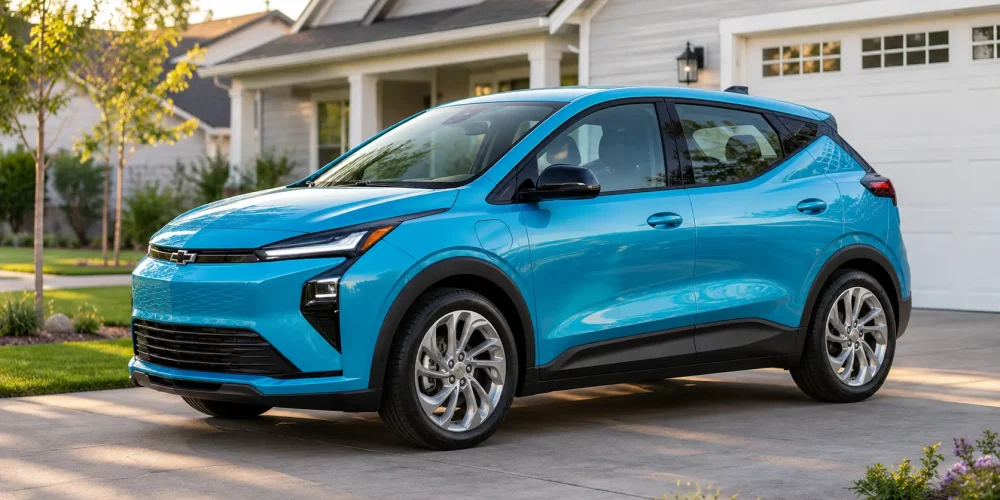
What the Bolt’s faster DC charging and new NACS port mean for daily driving, home charging, and road trips.
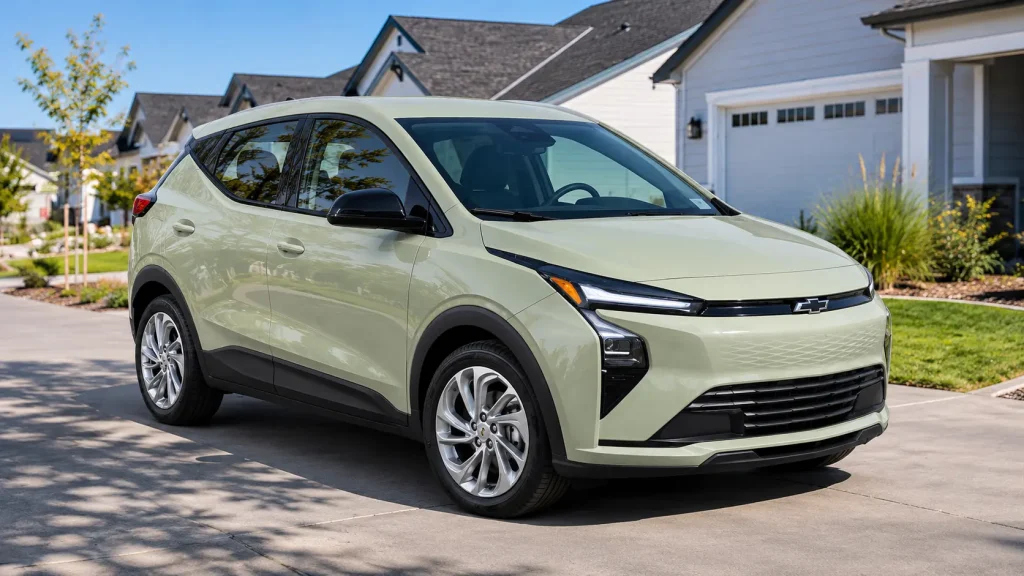
Chevrolet is putting affordability at the center of the Bolt’s return. Unveiled on October 9, 2025, the 2027 chevy bolt ev brings substantial charging and battery updates to a familiar compact hatchback formula. For drivers who liked the original car’s practicality but wanted shorter charging stops, those changes matter more than a new badge or a larger screen.
There is a caveat to the comeback. Reporting on its limited run suggests output could total roughly 35,000 vehicles before production ends in early 2027. That figure is a reported projection based on production pace, rather than a confirmed GM production target or a promise to build that many by the end of 2026.
For owners, the immediate question is simpler: how do you charge it? This 2027 Chevy Bolt charging guide covers the hardware, the estimated time involved, and what the electricity could cost, with separate treatment of Chevrolet’s published figures and our spreadsheet calculations.
1. Differences Between the 2027 Chevy Bolt and the 2023 Model
The most useful changes sit underneath the bodywork. The returning Bolt uses a 65 kWh lithium iron phosphate, or LFP, battery and switches to a native NACS charging port. LFP chemistry is known for thermal stability, although battery chemistry alone does not determine a vehicle’s overall safety.
The fast-charging upgrade is especially significant: the workbook’s 150 kW specification is approximately 2.7 times the previous model’s 55 kW figure. Peak power does not translate directly into an equivalent reduction in charging time, but it gives the new car much more headroom at a suitable station.
NACS also changes what owners need to carry. Compatible Tesla Superchargers can be used without a CCS-to-NACS adapter, while older J1772 AC chargers and CCS1 DC chargers require their respective approved adapters. A matching plug does not guarantee access to every station.
The Bolt also supports vehicle-to-home backup power when paired with a compatible, properly installed GM Energy system. This requires dedicated equipment, suitable home electrical infrastructure, and the applicable vehicle connection hardware. V2H capability should not be interpreted as permission to connect a generic adapter and power strip to the charge port; backup duration also depends on household demand and available battery energy.
2. 2027 Chevy Bolt Performance Specifications
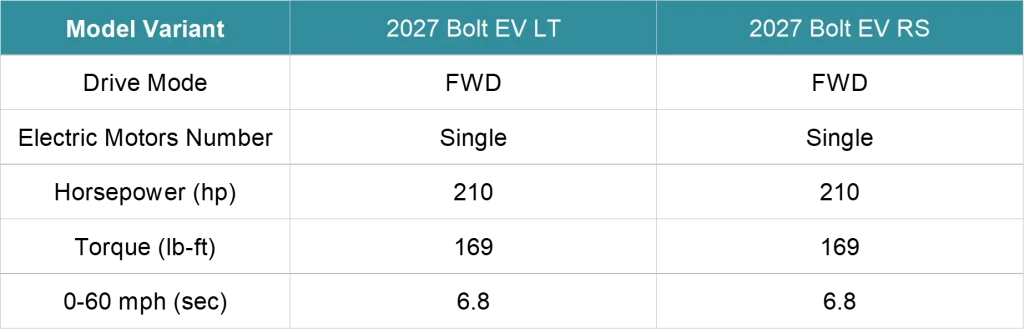
The LT and RS share the same core figures in the supplied workbook: one motor driving the front wheels, 210 hp, and 169 lb-ft of torque. Its listed 0–60 mph time is 6.8 seconds. The RS therefore should not be read as a separate, faster-charging powertrain in this comparison.
3. 2027 Chevy Bolt Charging Specifications
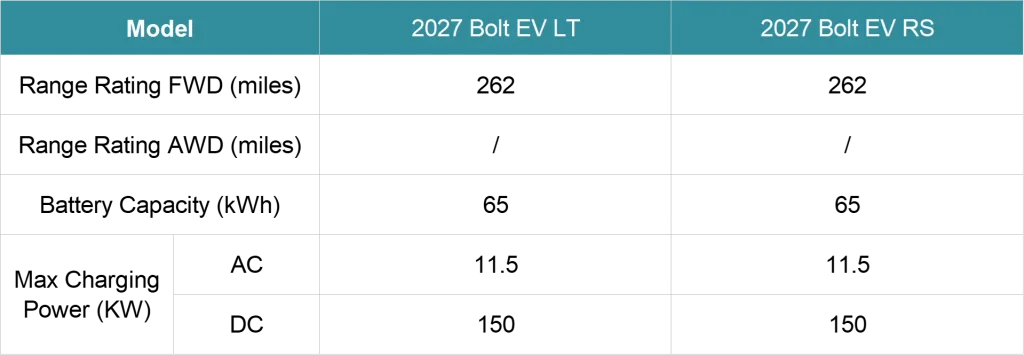
Both trims are listed with 262 miles of EPA-estimated range, a 65 kWh battery, up to 11.5 kW AC charging, and 150 kW DC charging capability. Chevrolet’s current consumer page describes DC capability as 150 kW+; the calculations below retain the workbook’s 150 kW input.
These numbers describe different things. Battery capacity is stored energy, measured in kWh. Charging power is the rate of energy transfer, measured in kW. The vehicle’s AC limit also means a more powerful home charger will not automatically charge this Bolt faster.
4. 2027 Chevy Bolt Charging Connector and Compatibility

The NACS inlet handles both AC charging and compatible DC fast charging. At home, a compatible native NACS charger provides a direct connection. To use an existing J1772 home or public AC charger, owners need a GM-approved J1772-to-NACS AC adapter suitable for the vehicle and charging current.
At CCS1 fast chargers, use an approved CCS1-to-NACS DC adapter. AC and DC adapters are not interchangeable, and an adapter intended for an older Bolt may work in the opposite direction.
Tesla Destination Charging is AC charging, while Supercharging is DC charging. Their similar connector shape does not make their charging speeds equivalent. For either, confirm that the site supports the vehicle and allows the intended use.
5. 2027 Chevy Bolt Charging Time
The EPA lists combined electricity consumption at 28 kWh/100 mi, with a combined efficiency rating of 120 MPGe. MPGe is an efficiency measure, not the car’s driving range.
The estimates below use a 65 kWh battery and 28 kWh/100 mi consumption. They are modeled comparisons, not measured charging sessions; actual results vary with temperature, starting charge, and station output.
EPA consumption includes charging losses, so applying further efficiency adjustments can count losses again. Treat the figures as estimates rather than exact predictions.
5.1 Charging at Home With Level 1

Level 1 is the slowest option, but a convenient outlet can still be useful for a lightly driven car or an occasional top-up. Chevrolet’s published 120V, 1.4 kW guidance is approximately 4 miles of range added per hour.
The revised model uses 120V at 16A, or 1.92 kW. For both trims, it estimates 5.83 miles per hour, 27.88 hours for 10%–80%, and 39.83 hours for 0%–100%. Adding 30 miles takes 5.15 hours; adding 100 miles takes 17.16 hours.
These theoretical results do not represent standard NEMA 5-15 performance: a 15A circuit generally allows no more than 12A for continuous charging. Follow the vehicle, cord, and circuit limits.
5.2 Level 2 Charging at 240V
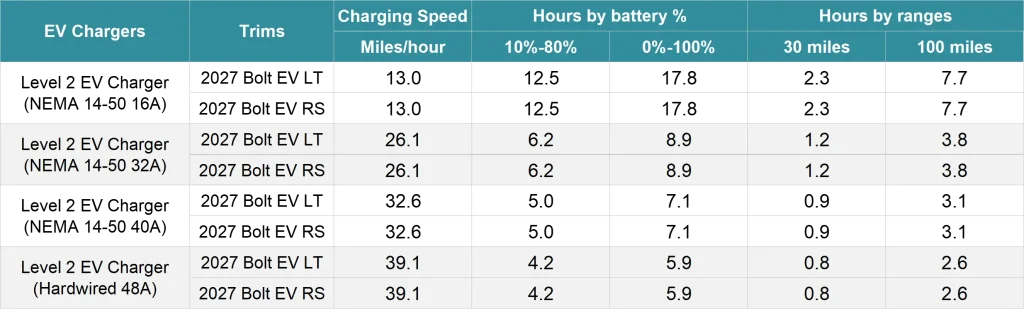
Level 2 is the more practical home setup for substantial overnight replenishment. LT and RS share the same modeled results; the image below provides the full comparison.
At 16A, the model estimates 13.03 miles added per hour and 17.82 hours for 0%–100%. Moving to 32A increases the rate to 26.06 miles per hour and reduces a full recharge to 8.91 hours.
At 40A, it estimates 32.57 miles per hour and 7.13 hours for 0%–100%. A hardwired 48A setup reaches approximately 39.09 miles per hour, with 4.16 hours for 10%–80% or 5.94 hours for 0%–100%.
A 40A plug-in setup typically uses a NEMA 14-50 outlet on a 50A circuit. For 48A charging, use an appropriate hardwired installation on a 60A circuit. The model’s 11.52 kW input is a close approximation to the vehicle’s published 11.5 kW capability.
Chevrolet publishes approximately 27 miles per hour at 7.7 kW and 40 miles per hour at 11.5 kW. Temperature, battery conditioning, and charging near full can extend the time required.
5.3 Public DC Fast Charging

Chevrolet estimates 10%–80% in 25 minutes under suitable conditions. The revised calculation gives 26 minutes for both LT and RS, putting the model close to that published benchmark.
The model also estimates 8.48 miles added per minute, or 3.54 minutes for 30 miles and 11.79 minutes for 100 miles. These constant-power illustrations use a higher effective power than the 10%–80% calculation and should not be interpreted as guaranteed stop durations.
No DC 0%–100% estimate is provided. Charging slows as the battery fills, so plan each stop around the energy needed for the next leg, battery temperature, and station performance.
6. Tesla Supercharger and CCS1 DC Charger Compatibility
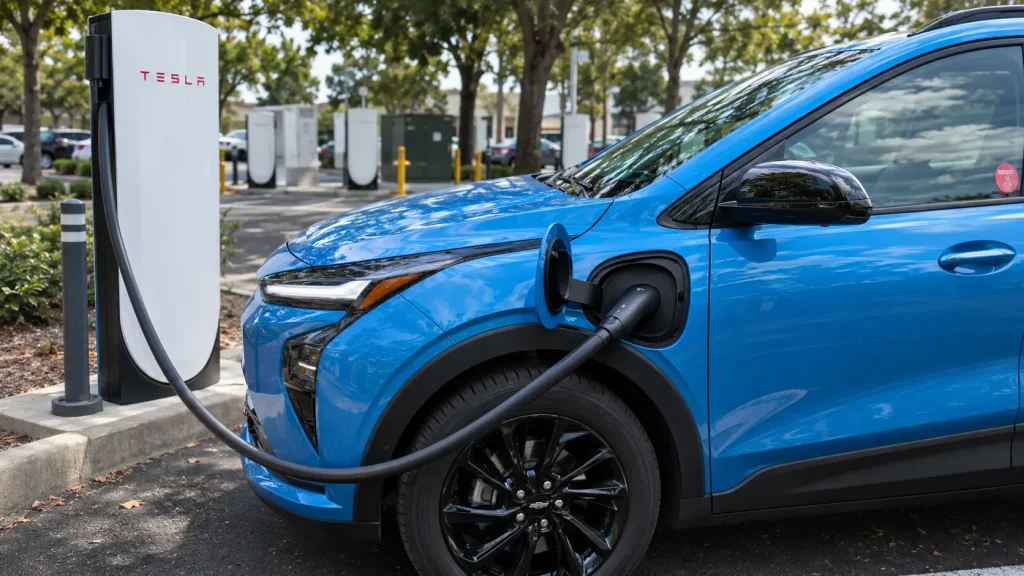
The native NACS port makes compatible Tesla Superchargers a simpler connection: there is no separate CCS1-to-NACS adapter between the station cable and the car. Before traveling, verify the specific location’s availability for GM vehicles and follow its payment or activation instructions. Older or restricted Superchargers should not be assumed compatible just because the connector fits.
A CCS1-to-NACS DC adapter remains useful on routes with CCS1 stations. Choose an approved adapter and check station power, operating status, and access hours before relying on a stop. A station rated above 150 kW will not force the Bolt to accept more power than the vehicle permits.
When navigation offers battery preconditioning for a planned fast-charging stop, use it. Arriving with the battery prepared can help charging performance, especially in cold weather. Build your route around compatible, working sites and a realistic reserve rather than the highest number on the charger cabinet.
7. Charging Cost of the 2027 Chevy Bolt
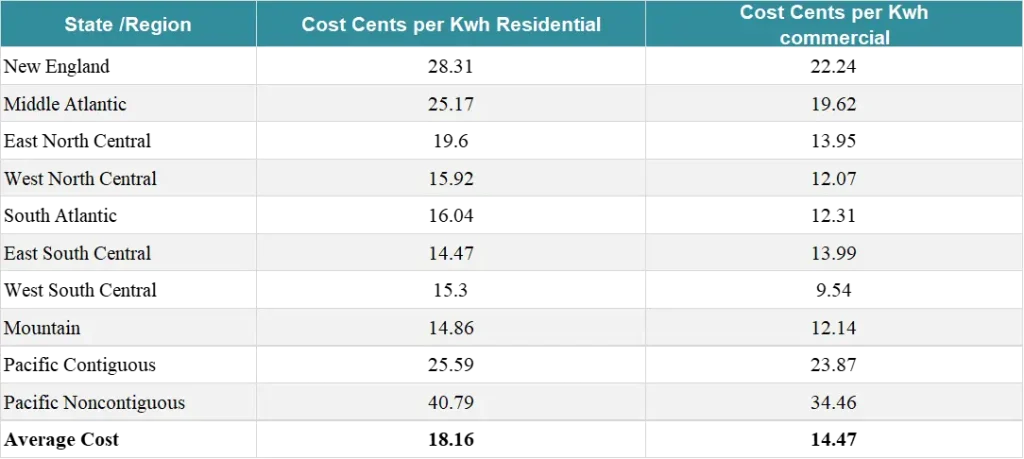
At the example rates of $0.182/kWh at home and $0.45/kWh at public chargers, both trims have the same modeled costs. Actual prices depend on the electricity plan and charging network, not the connector.

Home charging works out to $5.10 per 100 miles. The $11.83 figure represents 65 kWh at the example rate, before additional charging energy; it is not a measured empty-to-full bill.

Public charging works out to $12.60 per 100 miles using the EPA consumption proxy, or $29.25 for a 65 kWh purchase. Actual DC billing depends on energy metered and network fees, so neither figure guarantees a session total.
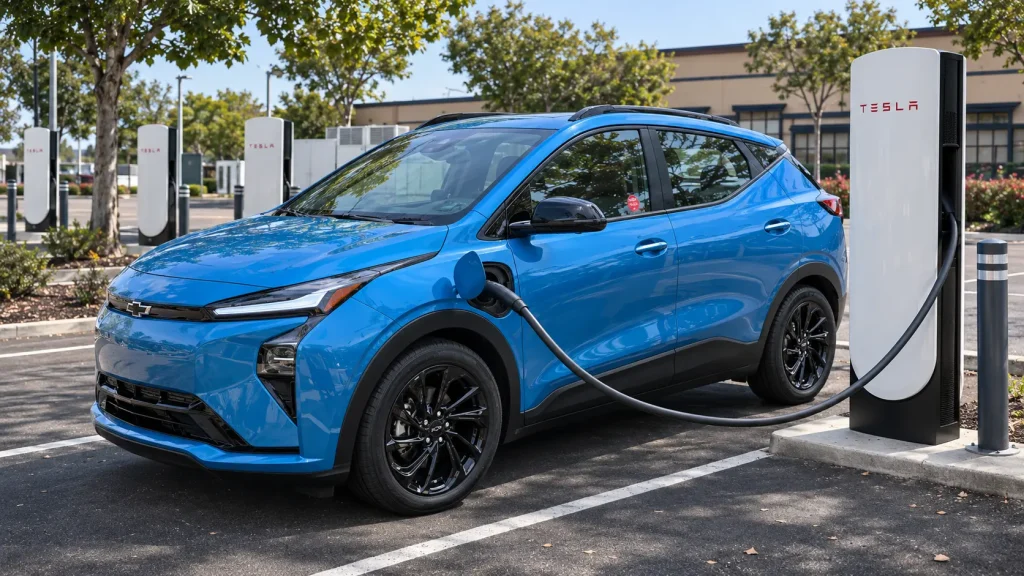
Routine home charging can cost substantially less than public fast charging. Time-of-use rates, charging losses, parking charges, and session or idle fees can change the final bill.
8. Choosing the Right Home Charger
Start with your daily mileage, parking arrangement, and available electrical capacity. A charger that replaces the previous day’s driving comfortably overnight may be all you need. The included dual-level charge cord is worth evaluating before buying another unit; Chevrolet lists approximately 7.7 kW capability on a suitable 240V supply.
A dedicated Level 2 home ev charger can provide a convenient permanent setup, but the linked unit has a J1772 connector. The 2027 Bolt requires a compatible, approved J1772-to-NACS AC adapter to use it. Confirm the charger, adapter, and installation ratings together, particularly if you want 48A charging.
A NACS portable ev charger offers a native connector and may be useful where a suitable 240V outlet is available. The linked 40A model requires the appropriate electrical supply; it cannot deliver 40A from an ordinary household outlet. Since the car already includes a portable dual-level cord, a second portable charger should solve a specific need, such as leaving one unit at home or accessing a higher supported current.
Have the installation assessed for the intended load, and use the vehicle’s charging schedule to take advantage of your electricity plan. For the LFP battery, follow the 2027 Bolt’s own charging guidance: Chevrolet recommends regularly charging it to 100% for accurate battery-level and range reporting. Do not automatically apply older Bolt charging habits to the new battery.
9. Conclusion
The 2027 Chevy Bolt makes its strongest charging case through faster DC capability and a native NACS port. At home, a suitable Level 2 setup should cover most replenishment needs; on a trip, Chevrolet’s 25-minute 10%–80% estimate is the useful published reference.
Choose hardware that matches the new inlet, budget using your actual tariff, and use the accompanying charging comparisons to find a setup that fits your routine.
FAQ
How long does it take to charge the 2027 Chevy Bolt?
Chevrolet estimates 25 minutes from 10% to 80% with suitable DC fast charging. The supplied Level 2 model gives approximately 5.94 hours for 0%–100% at 48A, or 8.91 hours at 32A. These home-charging figures are estimates; actual conditions and the final charging stage affect the time.
Can the 2027 Chevy Bolt use Tesla Superchargers?
Yes, at compatible locations open to the vehicle. Its native NACS port removes the need for a CCS1-to-NACS adapter at those sites. Verify station access and activation requirements before traveling.
Can I keep my existing J1772 home charger?
Potentially, with a compatible GM-approved J1772-to-NACS AC adapter. Confirm the adapter’s current rating and approved use. A CCS1 DC adapter does not replace the AC adapter required for a J1772 charger.
How much does charging cost?
Using the workbook’s example rates, the modeled cost is $5.10 per 100 miles at home and $12.60 per 100 miles at a public charger. Its $11.83 and $29.25 figures represent 65 kWh energy calculations, with the limitations explained above. Your actual bill depends on the tariff, energy metered, and extra fees.
Should I charge the LFP battery to 100%?
Follow the 2027 Bolt’s instructions rather than advice intended for older models. Chevrolet recommends regular charging to 100% to keep battery-level and range displays accurate. That does not mean every highway fast-charging stop needs to reach 100%; leaving earlier may save time once you have enough energy for the next leg.